
Have you ever noticed your child come home from school frustrated, unusually quiet, or overwhelmed — and then struggle to finish even the simplest homework task? Many parents describe moments like these when a child who is usually bright and capable suddenly “switches off.” It’s not laziness or lack of effort. More often, what you’re seeing is emotion overload in children — a state where feelings stack up faster than their still-developing brain can process them.
As an educator with over 15 years of experience, I’ve seen this pattern in countless classrooms. When emotions flood a child, learning becomes harder, not because they don’t understand the subject, but because their mind is busy trying to regain balance.
Today’s kids juggle academics, activities, social expectations, and big feelings — often without the emotional tools to navigate them. For school-age children (6–14 years), this emotional overwhelm can quietly affect attention, memory, confidence, and motivation.
This blog will help you understand why this happens, how it shows up in learning, and what parents can gently do to support their child’s emotional health. With the right awareness and habits — including calming practices like music — your child can learn to manage emotions and rediscover their joy in learning.
What Is Emotional Overload?
Emotion overload happens when a child’s emotional input exceeds their capacity to handle it. Think of it as a cup filling too quickly. Even one more drop — a tough math problem, a classmate’s remark, a correction from a teacher — can make it overflow.
Signs of emotion overload in children include:
- Difficulty focusing
- Forgetting instructions
- Irritability or shutdown
- Complaints of stomach aches or headaches
- Tearfulness or withdrawal
- Avoidance of schoolwork
- Overreacting to small issues
This is not a discipline issue. It is a regulation issue.
When a child’s emotional “cup” is full, learning cannot happen effectively — because emotional energy takes priority over cognitive tasks.
Understanding Emotion Overload in Children
Why This Matters for School-Age Kids
Between ages 6 and 14, the brain undergoes significant development in areas responsible for attention, emotional control, logic, and memory. Yet the emotional centers mature much earlier than the logical ones. This means children often feel big emotions intensely but lack the internal strategies to manage them.
When a child experiences:
- School pressure
- Friendship conflicts
- Fear of failure
- Overstimulation
- Academic expectations
- Too many activities
- Lack of rest
…the feelings can pile up until the brain goes into protective mode. Instead of processing new information, the child focuses on surviving the emotional wave.
For learning, this matters deeply.
A child in emotional overload is not ready to absorb lessons, follow instructions, or recall information — not because they can’t, but because their brain is temporarily overwhelmed.
How Emotional Overload Affects Learning: A Deep Dive
1. Impact on Attention and Focus
A child’s attention system works like a spotlight. When emotions take over, that spotlight flickers or dims. They may start homework but drift off, reread the same sentence multiple times, or forget what the teacher just said.
Why?
Because the brain is busy managing the emotional surge.
What this looks like at home:
- “Why aren’t you listening?”
- “I just explained this!”
- “You finished maths yesterday; why is it so hard today?”
None of this is intentional. Their brain simply cannot track information when overwhelmed.
2. Impact on Memory and Retention
Emotional overload directly affects the child’s working memory — the part used for problem-solving, storing instructions, and recalling facts.
A child may know the multiplication table on one day but go blank the next because emotional stress has temporarily disrupted their recall.
At Music Pandit, we often see children who struggle with memory on stressful days. Through rhythmic patterns and musical repetition, their memory becomes stronger once emotions settle.
3. Impact on Confidence and Self-Worth
When a child feels overwhelmed, they often interpret their struggles as a personal failure:
- “I’m bad at maths.”
- “Everyone else understands except me.”
- “I keep disappointing my teacher.”
Over time, emotional overload can lead to self-doubt, perfectionism, or fear of trying — all of which affect academic growth.
4. Impact on Motivation
Emotionally overloaded children often avoid tasks not because they don’t care, but because they fear more overwhelm.
This might look like:
- Procrastination
- Disinterest
- Slow work pace
- Wanting frequent breaks
Parents sometimes misread this as laziness. In truth, your child is trying to protect themselves from further emotional strain.
5. Impact on Social Learning
School isn’t just academics. Children learn teamwork, empathy, communication, and problem-solving in social settings.
Emotion overload can cause:
- Withdrawal from friends
- Increased sensitivity
- Quick frustration in group work
- Misinterpreting tone or body language
When emotions run high, social understanding declines, making school feel even more stressful.
Why Today’s Kids Experience More Emotional Overload
1. Higher academic expectations
Kids are asked to learn more at younger ages.
2. Overscheduled lives
Classes, homework, co-curriculars, sports — everything adds up.
3. Digital overstimulation
Constant content keeps the brain in a heightened state.
4. Reduced downtime
Rest and unstructured play — both essential for emotional processing — have been reduced.
5. Modern social pressures
Bullying, comparison, and friendships feel more complex today.
Knowing the “why” helps parents respond with compassion instead of worry.
A Child Psychology Lens: What’s Happening in the Brain?
- The amygdala (emotion center) becomes highly activated.
- The prefrontal cortex (logic, planning, focus) temporarily reduces activity.
- Stress hormones like cortisol rise, making the child feel anxious or distracted.
- Learning pathways weaken until emotional balance returns.
This is reversible. With support and regular emotional regulation activities, the brain becomes stronger over time.
Everyday Examples: How Emotion Overload Shows Up in Real Life
1. The Morning Meltdown
Your child wakes up tired after a busy week. A minor issue — like the wrong tiffin or misplaced socks — triggers tears. At school, they struggle to focus and return home exhausted.
2. The Homework Block
They sit for homework but feel overwhelmed looking at the page. A simple mistake causes frustration. They say, “I can’t do this,” even though they did similar work last week.
3. The Classroom Freeze
When called on, they freeze, afraid of being wrong. Even if they know the answer, fear blocks expression.
4. The Overpacked Schedule
Between tuition, sports, music lessons, and homework, they have no downtime. Any extra task feels like too much.
Parents everywhere face these situations. You’re not alone — and your child is not “difficult.” They’re overwhelmed.
Healthy Ways to Support a Child Experiencing Emotional Overload
1. Help Them Slow Down
Children often need permission to pause. Short breaks, quiet time, and unstructured play restore emotional balance.
What parents can try:
- 10 minutes of silent drawing
- Gentle stretches
- Deep breathing
- Calming music
2. Validate Their Feelings
A simple “I can see you’re feeling overwhelmed; let’s take a moment” tells your child they are safe and supported.
Never underestimate the power of empathy.
3. Break Tasks Into Smaller Steps
Instead of “Finish your homework,” try:
- “Let’s do question 1 together.”
- “Take a two-minute break, then we’ll continue.”
Chunking reduces emotional strain.
4. Create Emotion-Friendly Routines
Predictability reduces the emotional load.
Ideas:
- Light music during study time
- Short breaks between subjects
- A calming bedtime routine
- Morning check-in conversations
5. Use Music as an Emotional Regulator
Music is one of the most powerful tools for emotional balance.
How music helps emotions:
- Lowers stress hormones
- Regulates breathing
- Improves mood
- Increases focus
- Strengthens memory
- Builds confidence through self-expression
Inside online music classes, children receive structured, calming, and creative experiences that help them release emotions and reconnect with learning joyfully.
At Music Pandit, our teachers often notice children becoming more focused and emotionally grounded after musical warm-ups, rhythmic exercises, or guided songs.
Music becomes a safe space — especially for sensitive kids.
How Parents Can Recognise Progress
As emotional overload decreases, you may notice:
- Better attention and less fidgeting
- Fewer meltdowns over homework
- More willingness to try difficult tasks
- Improved academic performance
- Better sleep
- More joyful conversations about school
- Calmer mornings and smoother evenings
Progress is rarely linear, but consistent emotional support builds a stronger, more resilient learner.
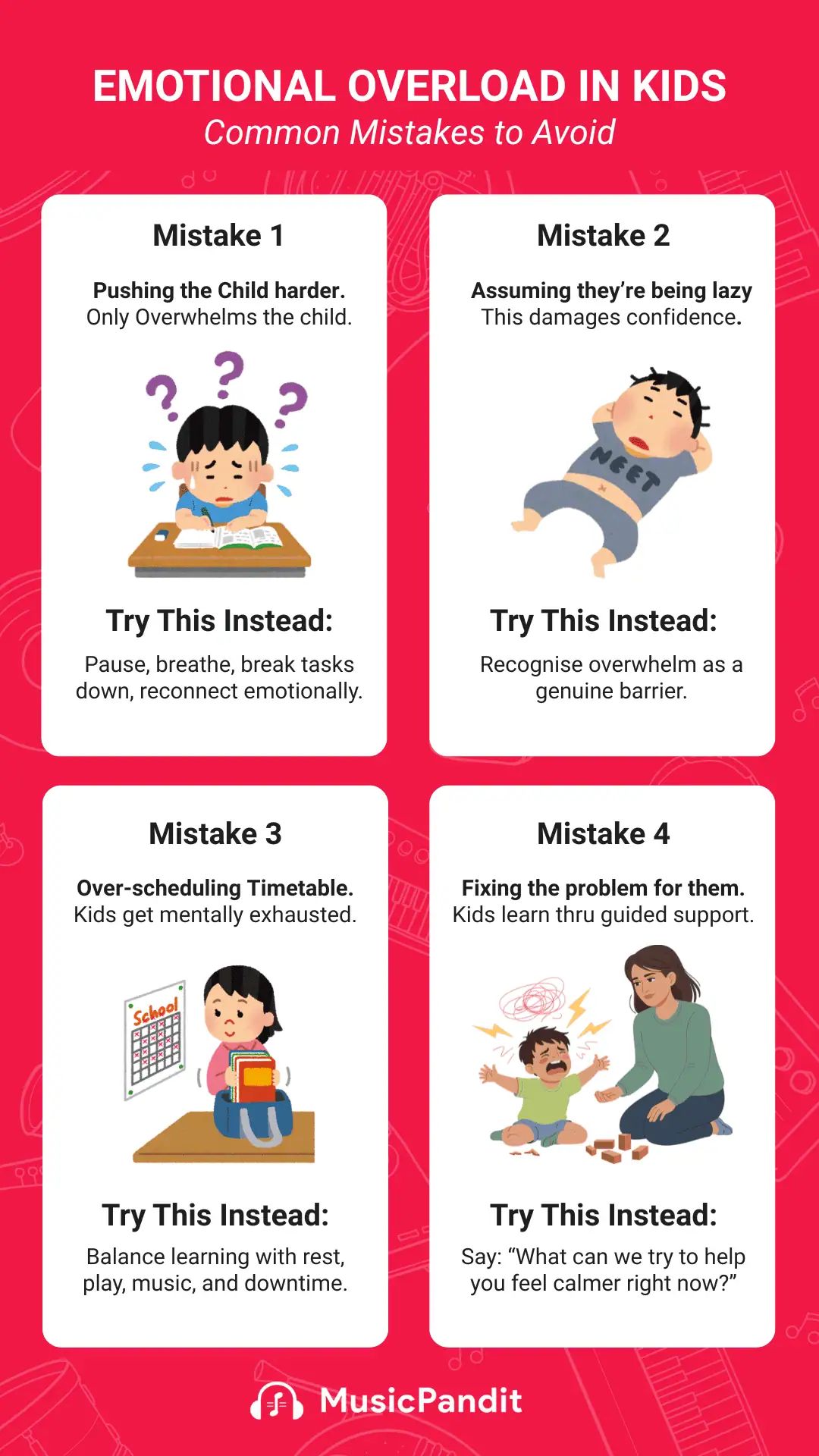
Common Mistakes Parents Make (And Gentle Alternatives)
Mistake 1: Pushing the child harder
Overwhelm increases.
Try instead:
Pause, breathe, break tasks down, reconnect emotionally.
Mistake 2: Assuming they’re being lazy
This damages confidence.
Try instead:
Recognise overwhelm as a genuine barrier.
Mistake 3: Over-scheduling
Kids may appear capable but mentally exhausted.
Try instead:
Balance learning with rest, play, music, and downtime.
Mistake 4: Fixing the problem for them
Children must learn emotional regulation through guided support.
Try instead:
Coach them:
“What can we try to help you feel calmer right now?”
The Music Pandit Perspective
At Music Pandit, we see thousands of children each week across different age groups, temperaments, and learning styles. We’ve noticed that when children feel emotionally safe, curious, and supported, their academic and musical abilities flourish naturally.
Our online music classes are intentionally structured to help children:
- Slow down and express themselves
- Build emotional vocabulary
- Strengthen focus through rhythm
- Develop confidence with gentle guidance
- Experience learning as joyful, not stressful
Music itself becomes a tool for emotional regulation — something children carry into their schoolwork, friendships, and daily life.
This emotional grounding often translates into better classroom participation, improved memory, calmer behaviour, and a renewed love for learning.
Practical Takeaways for Parents
✔ Observe your child’s emotional triggers
Notice patterns — mornings, homework time, social situations.
✔ Build daily emotional regulation moments
Music, breathing, movement, journaling, and affection.
✔ Keep routines predictable
Predictability lowers stress.
✔ Avoid comparison
Every child processes emotions differently.
✔ Encourage expression
Art, music, storytelling and conversation – all help release emotions.
✔ Make your home a safe emotional space
Calm tones, active listening, and warmth go a long way.
Conclusion
Childhood is filled with emotions — big, surprising, and sometimes overwhelming. When these feelings pile up, learning becomes harder, not because your child is incapable, but because their heart needs attention before their mind can open. Understanding emotion overload in children helps you respond with empathy instead of pressure, support instead of frustration.
With steady routines, open conversations, and calming practices like music, children rediscover balance. If your child enjoys creative, soothing learning environments, they may thrive in guided experiences like online music classes, where emotional regulation and joyful expression naturally blend. At Music Pandit, we’ve seen how small musical moments can restore confidence and help children learn with ease — one gentle beat at a time.
You’re not just supporting academics. You’re nurturing a resilient, emotionally healthy child. And that is the most meaningful learning of all.












 Chat with us