
Your child moves from one activity to another within minutes. Drawing, playing, talking, then switching again.
As a parent, it’s natural to wonder why your child can’t stay focused for long. Many parents today share the same worry, especially as attention spans seem much shorter than before. But this shift is not unusual.
Science shows that modern children experience the world differently, and their attention works differently, too. What would be the reason for a shorter attention span?
As a parent, do you wonder how to increase your child’s attention span with simple activities?
If so, read this article in full.
What is “Attention Span” in simple words?
Attention span is simply how long a child can stay focused on one activity without getting distracted.
As children grow, their ability to pay attention also grows.
Attention span usually grows as we move from childhood into early adulthood.
It reaches its highest point around the early 40s and then slowly decreases as we get older. This is a normal part of how the brain develops and changes over time. Factors like the environment and personal differences also play a role in how attention grows.
Infants and toddlers have very short attention spans; sometimes just a few seconds to a couple of minutes, because they learn by exploring everything around them.
In early childhood (ages 3–6), their attention improves, and they can focus for 5–15 minutes.
As they grow older, their ability to stay focused keeps getting better.
School-age children can usually concentrate for 15–30 minutes, and by the teenage years, their attention span becomes similar to adults, often lasting 30 minutes to more than an hour.
Is this the attention span of kids living in the AI era?
Of course, if you are a parent of Alpha or Beta kids, you may not agree with this data.
Let’s look at it in detail and see what science says about the attention span of today’s children.
Are Kids Today Really Less Focused Than Before?
Preschool teachers often say that children are unable to focus in class. When they speak with parents, they usually find that excessive screen time is the primary reason.
This is sometimes called ‘virtual autism.’ It is not an official medical diagnosis, but it describes attention and focus problems caused by heavy digital exposure during early childhood.
This is due to the world around them having changed in big ways. Kids now grow up with constant screens, fast content, noisy environments, and many things competing for their attention. Their brains are not “broken”—modern life simply gives them more stimulation than they can handle.
Experts also note that not all attention problems come from ADHD. Sometimes stress, poor sleep, fast-paced media, or lack of outdoor play can affect focus.
So, while it may appear that children are less focused, much of it stems from how their environment and daily experiences have changed.
You already understand the factors that influence a child’s attention span. But what does science say? Shall we look deeper into it?
Why Modern Kids Have Shorter Attention Spans? Science-Backed Reasons
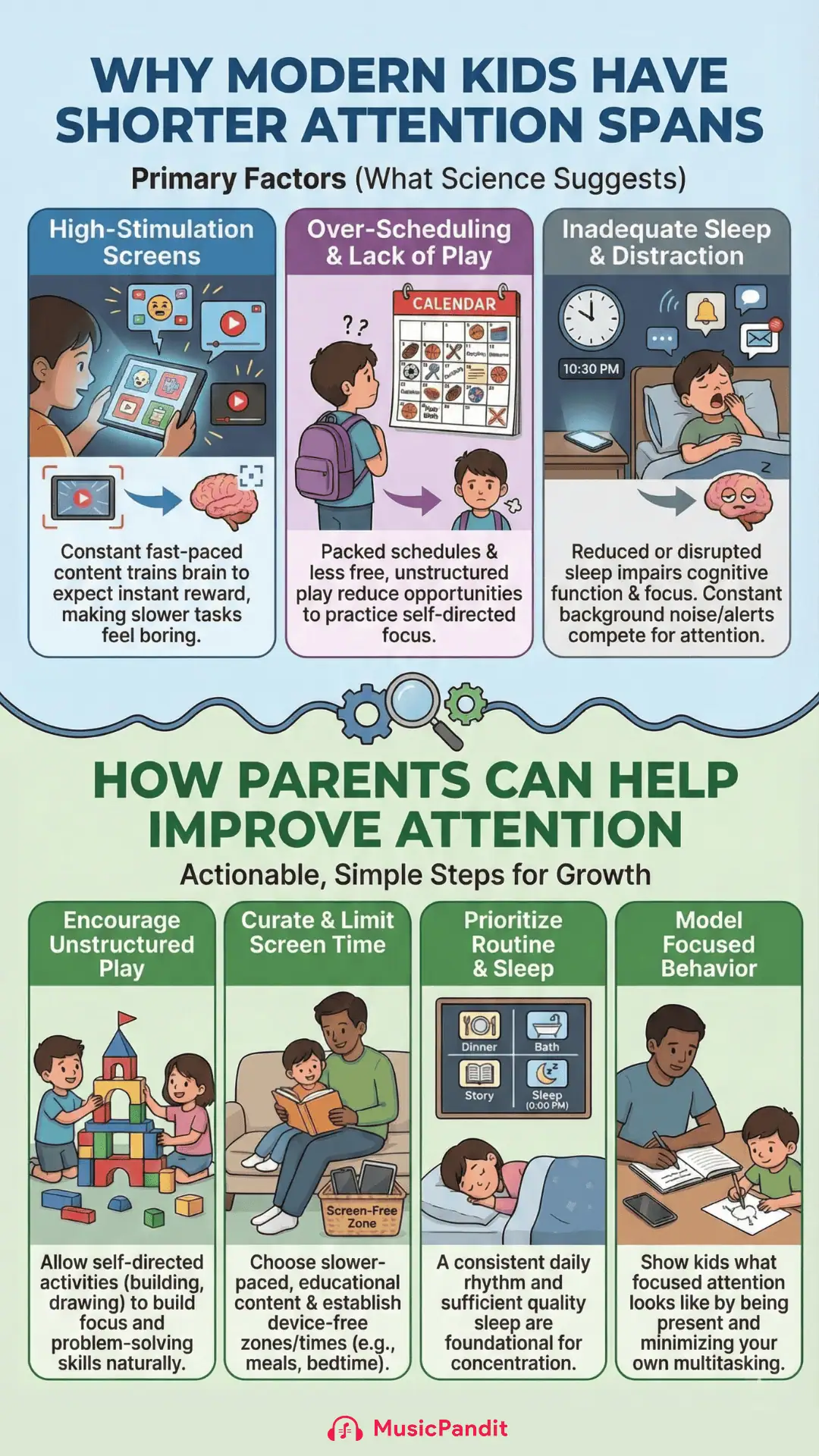
Many parents report that children today lose focus more quickly than before. Science shows that this is not because kids have changed, but because their world has changed.
Growing brains, fast-paced technology, busy schedules, and constant stimulation all shape how children pay attention.
Understanding these factors helps us see why modern kids struggle with long, slow tasks and why their attention works differently from earlier generations.
1. Their Brains Are Still Developing
Children’s brains, especially the parts that control focus and self-control, grow slowly over many years. Because these areas are still developing, kids naturally switch between activities more often. Their attention strengthens with age, but it takes time. So, quick task-shifting is normal in childhood, not a sign of a problem.
2. Too Much Fast-Paced Screen Exposure
Many kids spend a lot of time watching fast, colorful, and constantly changing videos. This type of content trains the brain to expect quick rewards and nonstop stimulation.
As a result, slower activities, such as reading, writing, listening in class, or playing with real toys, may feel boring. The brain gets used to speed and struggles with tasks that require patience.
3. Multitasking and Constant Switching
Children today often use several devices or apps at the same time- watching videos while texting, or switching between games and homework.
Multitasking makes the brain jump quickly from one thing to another. Over time, this reduces the ability to stay focused on a single task. The more kids switch, the harder it becomes to stay with one activity for long.
4. Not Enough Boredom or Slow Play
Boredom is not a bad thing. It teaches the brain to slow down, think deeply, and create new ideas. Earlier generations had more unstructured play, imagining, or exploring outside.
Today, kids often move from one planned activity to another or spend free time on screens. With less slow play, they get fewer chances to build long, steady attention.
5. Stress, Sleep Issues, and Busy Schedules
Many children deal with stress from school, family routines, or pressure to perform. Poor sleep also affects the brain’s ability to concentrate the next day.
When kids follow tight, busy schedules, their minds don’t get enough rest. This mental overload makes it harder for them to focus, stay calm, or finish tasks without distraction.
What does a short attention span actually look like? Any ideas!
How short attention spans show up at home?
You can often spot short attention spans in everyday situations. Here are some common signs parents notice:
- Switching tasks often: Your child starts an activity, plays for a few minutes, then quickly moves to something else without finishing the first task.
- Difficulty finishing homework: They sit with their books but keep getting up, looking around, or asking for breaks because they cannot stay focused for long.
- Saying “I’m bored” frequently: They lose interest quickly, even in activities they usually enjoy, because they want something new or exciting all the time.
- Getting distracted during conversations: While you talk to them, their eyes wander, they interrupt, or they drift into another topic before you finish.
- Losing items often: They misplace toys, pencils, or school items because they are not paying attention to where they keep things.
- Trouble following instructions: You give simple steps, but they forget or skip parts because they weren’t fully focused when listening.
These signs are common in many children, especially in a world full of distractions.
The situation is clear, but is there a solution? As a parent, you can try these tips. I personally recommend them to the families who come to Music Pandit.
These suggestions come from psychologists, so you can trust them.
How Parents Can Help Improve Attention?
Parents play an important role in shaping how children learn to focus. Small, consistent changes at home can strengthen attention and make daily tasks easier.
By creating a calm environment, reducing distractions, and supporting healthy routines, parents can help children build steady and lasting concentration. Here are a few simple ways to support better focus.
1. Encourage One Task at a Time
Help your child focus by giving them only one activity at a time. Remove extra toys, gadgets, or unnecessary books from their study area.
When they do homework, keep the table clean and turn off the TV or background screens. This helps their brain stay with one task instead of jumping from one thing to another.
2. Set Healthy Screen Boundaries
Screens are a big part of children’s lives, but they need limits. Reduce fast-paced content like quick videos, reels, and shorts because they train the brain to expect constant excitement. Make clear rules for screen time, such as no screens during meals or homework. Avoid screens at least one hour before bed, as they affect sleep and make the next day’s focus weaker.
3. Bring Back Slow, Offline Play
Slow and simple activities help children build patience and deeper focus. Encourage them to draw, solve puzzles, play with blocks, read books, or spend time outdoors.
These activities give their brain a break from fast-paced digital stimulation and help strengthen their attention naturally. Even 20–30 minutes of quiet play can make a big difference.
4. Build a Simple Daily Routine
A predictable routine helps the brain stay calm and organised. Fix regular times for sleep, meals, homework, and play. Consistent sleep improves memory, mood, and attention during the day. When children know what to expect, they feel more settled and find it easier to stay focused on tasks.
These small, daily habits support better attention and help children stay calm, alert, and more connected to the world around them.
5. Try Activities That Increase Focus
Try activities that naturally help children focus. Simple musical activities can improve listening, patience, and attention. When kids follow a rhythm, repeat patterns, or listen carefully to sounds, their brain learns to slow down and concentrate. You can also use puzzles, building blocks, or matching games to support focus. The idea is to choose activities that gently train the mind to stay with one task at a time.
When to Seek Professional Help?
Most children struggle with attention at times, and this is completely normal. But if you notice that focus problems continue for several months and start affecting daily life, it may help to speak with a professional.
You may consider reaching out for support if your child’s schoolwork drops, if teachers regularly express concern, or if your child has trouble keeping friendships because they can’t listen or stay engaged. A trained expert can guide you, check for underlying issues, and suggest the right steps. Seeking help is not a sign of failure—it’s simply a way to better support your child.
If you are a parent and you have read this far, you don’t need to panic about your child’s attention. But you must remember a few important things. Just keep them in mind.
What Parents Should Keep in Mind About Kids
- Children are naturally active, curious, and full of energy.
- Modern life adds many distractions, especially through screens and fast-paced content.
- Slow, offline play gives children the space to build stronger attention.
- Healthy routines, good sleep, and calm environments support better focus every day.
- Creative activities, including simple music tasks, help improve long-term attention.
- With steady, small changes, children can learn to focus better over time.
Every child’s attention grows slowly, step by step. You don’t need big changes to make a difference. Small, daily habits can gently strengthen their focus. Support your child with patience, understanding, and simple routines. With your guidance, their attention will become stronger and steadier over time.















 Chat with us