
Strings of a guitar are the long, thin metal or nylon wires stretched across the instrument that produce sound when plucked, strummed, or picked. Each string creates a different pitch, and together they form the foundation of all guitar playing.
What are the Strings of a Guitar?
The strings of a guitar are the primary sound-producing parts of the instrument. When a player plucks or strums them, they vibrate and create musical notes. These strings are usually made of steel, bronze, nickel, or nylon, depending on the type of guitar.
In everyday music learning, children recognise guitar strings as “numbered lines” or as names such as E, A, D, G, B, and E. For example, on a standard six-string guitar, the thinnest string is the 1st string (high E), and the thickest string is the 6th string (low E). Together, they help students play melodies, chords, and patterns.
Why is it important to understand Strings in Guitar?
- They produce all the sound: Without strings, a guitar cannot make music. Understanding strings helps children control tone and volume.
- They guide musical structure: Strings provide specific pitches, allowing learners to play scales, melodies, and chords accurately.
- They build hand coordination: Practising on strings improves finger strength, dexterity, and coordination.
- They support musical creativity: Different strings offer different tonal colours, encouraging children to explore their own musical ideas.
- They teach pattern recognition: Identifying string numbers and note names helps kids develop pattern awareness, which is vital for learning songs.
Guitar String Names and Numbers
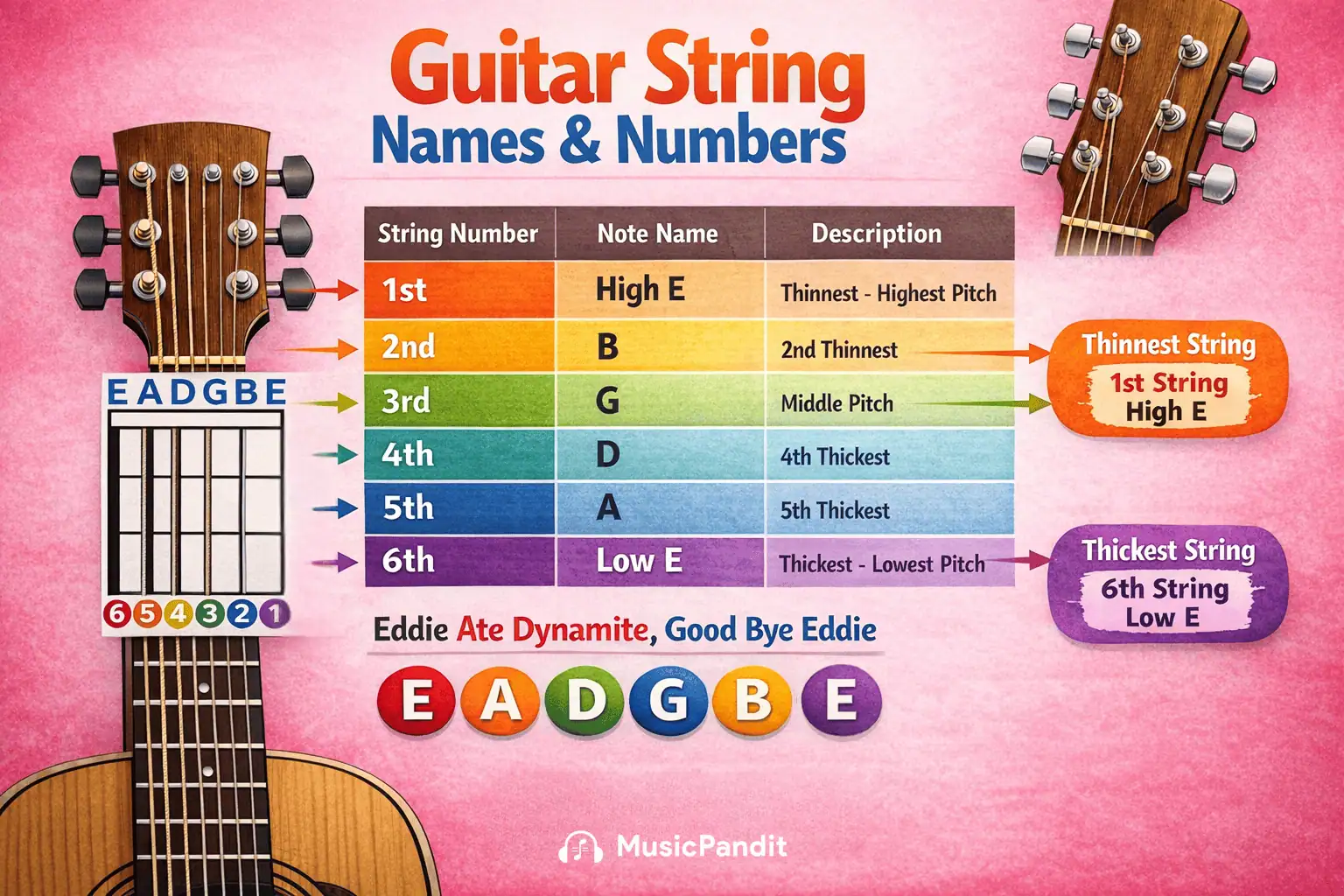
On a standard six-string guitar, each string has both a name (based on its pitch) and a number (based on its position). Understanding guitar string numbers makes it easier to follow lessons, read chord charts, and communicate with other guitar players.
The strings are counted from the thinnest string to the thickest:
- The 1st string is the thinnest and highest-sounding string
- The 6th string is the thickest and lowest-sounding string
In standard tuning, the open strings are tuned to the notes E–A–D–G–B–E.
| String Number | Common Name | Letter Name (Open String) | Quick Note |
| 6th | Low E string | E | Thickest, lowest pitch |
| 5th | A string | A | 2nd thickest |
| 4th | D string | D | Middle-low |
| 3rd | G string | G | Middle |
| 2nd | B string | B | 2nd thinnest |
| 1st | High E string | E | Thinnest, highest pitch |
You’ll notice that E appears twice—once as the lowest string and once as the highest. These are commonly referred to as low E (6th string) and high E (1st string). Even though they share the same letter name, they sound very different because they are in different pitch ranges.
Why string numbers matter
String numbers are used constantly in guitar learning:
- Guitar teachers often say things like “play this note on the 5th string”
- Tabs and exercises may refer to string numbers instead of note names
- Chord diagrams are easier to understand when you know which string is which
Once you know the relationship between the string names and their numbering, navigating chords, scales, and lessons becomes much more intuitive.
A simple way to remember the String order
Many players remember the string order using a phrase:
“Eddie Ate Dynamite, Good Bye Eddie.”
Each word represents the open strings from the lowest to the highest.
Types of Guitar Strings
1. Steel Strings
These are metal strings used mainly on acoustic and electric guitars.
Example: A child learning Bollywood or pop guitar usually plays on steel strings for a bright, clear sound.
2. Nylon Strings
These soft, flexible strings are used on classical guitars.
Example: Beginners sometimes prefer nylon strings because they are gentle on the fingers.
3. Wound Strings
These strings have a metal winding wrapped around a core, producing deeper, warmer tones.
Example: The 4th, 5th, and 6th strings on most guitars are wound.
4. Plain Strings
These are smooth, unwound strings that produce higher pitches.
Example: The 1st and 2nd strings (E and B) are usually plain steel or nylon.
String Gauges (Thickness)
The gauge affects how the string feels and sounds. Lighter gauges are easier to press, while thicker gauges produce fuller tones.
Example: Many young learners start with light-gauge strings to reduce finger discomfort.
How to Tune Guitar Strings
Tuning keeps the guitar sounding clear and helps children develop a good musical ear. Here is a simple, quick guide.
Standard Tuning of Strings
The most common tuning is E–A–D–G–B–E from thickest to thinnest string.
Example: A simple G major chord uses the 3rd fret on the thick E string, 2nd fret on the A string, and open D, G, B, and high E strings.
Basic Steps to Tune a Guitar
- Know the Standard Tuning: E – A – D – G – B – E (thick to thin).
- Use a Digital or App-Based Tuner: pluck each string and adjust the tuning peg slowly until the tuner indicates the correct pitch.
- Tune Up for Accuracy: If the string is too high, loosen it a little, then tighten up to the correct note.
- Tune in a Quiet Room: This helps both the tuner and the child hear the pitch clearly.
- Recheck All Strings: Small adjustments on one string can affect others, so checking a second time helps.
- Help Children Listen: Let them hear the difference before and after tuning to build confidence.
Always remind children: turn the pegs slowly- tiny movements make big changes.
Master the Guitar Strings!
For Beginners at Home
- Ask your child to say the string numbers aloud while pointing to them.
- Use simple games like “Which string sounds higher?” to build listening skills.
- Encourage them to pluck each string gently to feel how vibration creates sound.
- Let them practise tuning with adult supervision to build confidence and responsibility.
For Instrument Players
- Start by memorising string numbers and names using repeated warm-ups.
- Practise plucking each string individually with downstrokes and upstrokes.
- Play simple melodies on one string to build finger independence.
- Use a tuner regularly to keep strings in tune—this trains the ear and improves accuracy.
- Explore chords by pressing multiple strings simultaneously while strumming.
Common Mistakes to Avoid
- Ignoring tuning → Make regular tuning a habit before every practice session.
- Using old or rusty strings → Replace strings regularly to protect fingers and improve sound quality.
- Confusing string numbers → Use clear mnemonics such as “Every Amateur Does Get Better Eventually.”
- Pressing too hard on the strings → Teach children to use just enough pressure to produce a clean note.
- Strumming too close to the bridge → Guide them to strum in the centre for a fuller, warmer tone.
Related Music Terms
- Chord – A group of notes played together to create harmony.
- Scale – A sequence of notes arranged in ascending or descending order.
- Fret – A metal strip on the guitar neck that helps players find accurate pitches.
- Tuning – Adjusting string tension so that each string produces the correct pitch.
- Melody – A sequence of notes that forms a tune.
Want your child to really understand Guitar?
When children realise that each string produces a distinct sound and serves a specific purpose, they begin to take ownership of their playing. In my classes, I often spend time helping students explore the colours of each string- hearing the deep warmth of the low E or the bright sparkle of the high E. This simple awareness transforms their musicality.
At Music Pandit, we teach guitar in a structured yet joyful way. Children learn through guided activities, clear demonstrations, and personalised feedback that encourages steady progress. If you want your child to build a strong foundation in guitar, starting with mastering the strings is the perfect first step.















 Chat with us