
The Trinity of Carnatic Music refers to Tyagaraja, Muthuswami Dikshitar, and Syama Sastri– three legendary composers whose works shaped the foundation of Carnatic classical music. Their compositions (kritis) continue to guide how children learn ragas and talas.
What is the Trinity of Carnatic Music?
The Trinity of Carnatic Music represents the three most influential composers of the 18th–19th century: Tyagaraja, Muthuswami Dikshitar, and Syama Sastri. They lived around the same time in Thanjavur and created thousands of compositions that became the backbone of Carnatic learning.
Their kritis are not just songs—they are musical lessons. Through them, children learn how every raga has a mood, every phrase has meaning, and every tala builds discipline.
For example, when a child learns “Vatapi Ganapatim” or “Nagumomu Ganaleni,” they learn pitch control, emotive singing, and rhythmic steadiness effortlessly.
How did this Trinity influence Carnatic Music?
- They form the core of Carnatic music learning – Most students begin their musical journey with Tyagaraja or Dikshitar kritis.
- They show different ways of expressing the same raga – Children begin to hear the difference in style, phrasing, and movement.
- They help build musical discipline– slow singing (vilamba kala), gamakas, tala patterns—everything becomes clearer.
- They connect children to culture and heritage – These songs carry stories of devotion, inspiration, and Indian classical identity.
- They are timeless – Even today, concerts, exams, and Carnatic curricula revolve around their works.
Know more about the Trinity
Tyagaraja
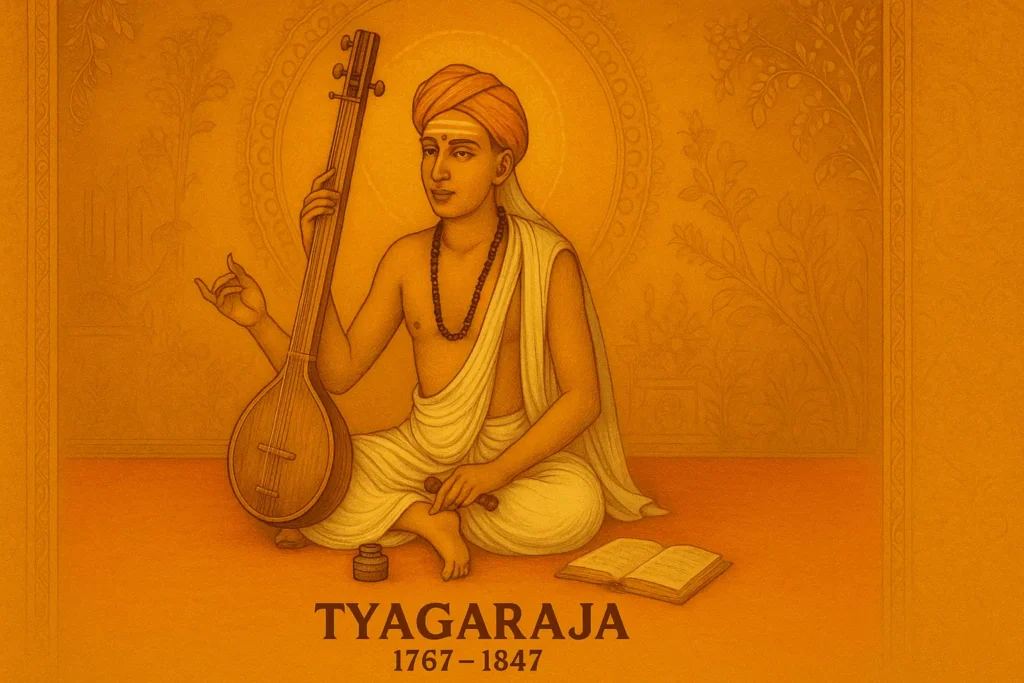
Tyagaraja (1767–1847) composed over 600 kritis, mostly in Telugu, filled with devotion to Lord Rama.
Style: Emotional, melodic, expressive.
Popular Kritis for Students:
- “Nagumomu Ganaleni” – Raga Abheri
- “Endaro Mahanubhavulu” – Raga Sri
- “Sadhinchene” – Raga Arabhi
- “Raghuvamsa Sudha” – Raga Kadanakuthuhalam
- “Seethamma Mayamma” – Raga Vasantha
These are often the first few Tyagaraja kritis teachers introduce because they are accessible yet rich.
Muthuswami Dikshitar
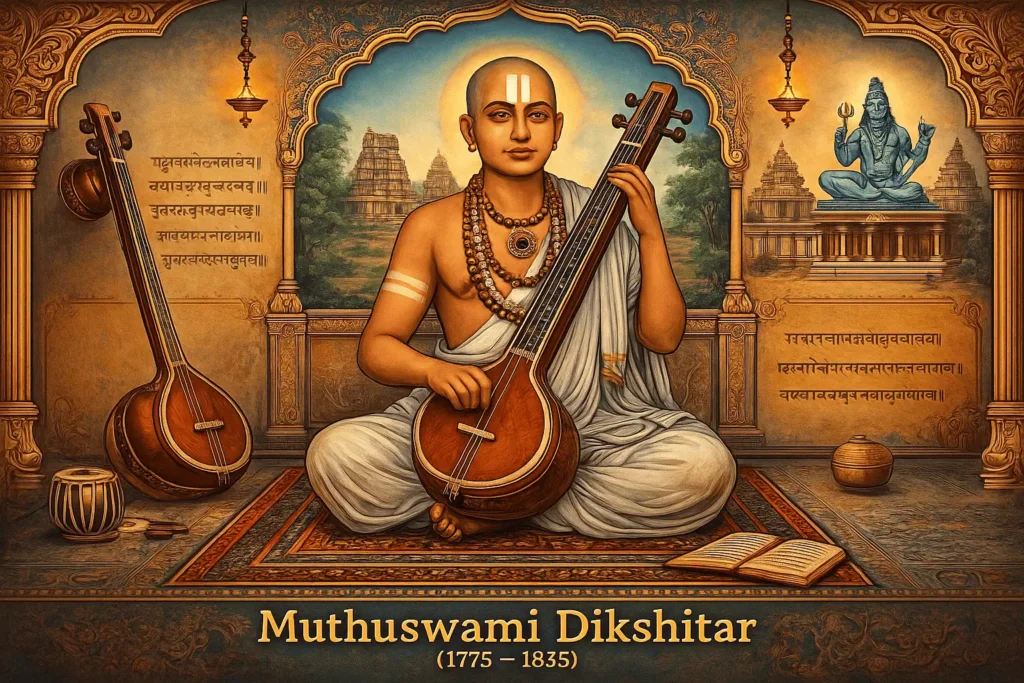
Muthuswami Dikshitar (1775–1835) is admired for his scholarly approach, Sanskrit lyrics, and meditative pace.
Style: Structured, detailed, deeply classical.
Popular Kritis for Students:
- “Vatapi Ganapatim” – Raga Hamsadhwani
- “Sri Saraswati Namostute” – Raga Saraswati
- “Annapoorne Visalakshi” – Raga Sama
- “Kamalamba Navavarna Kritis” – Set of devotional masterpieces
- “Parimala Ranganatham” – Raga Hamir Kalyani
These compositions help children improve breath control and awareness of raga structure.
Syama Sastri
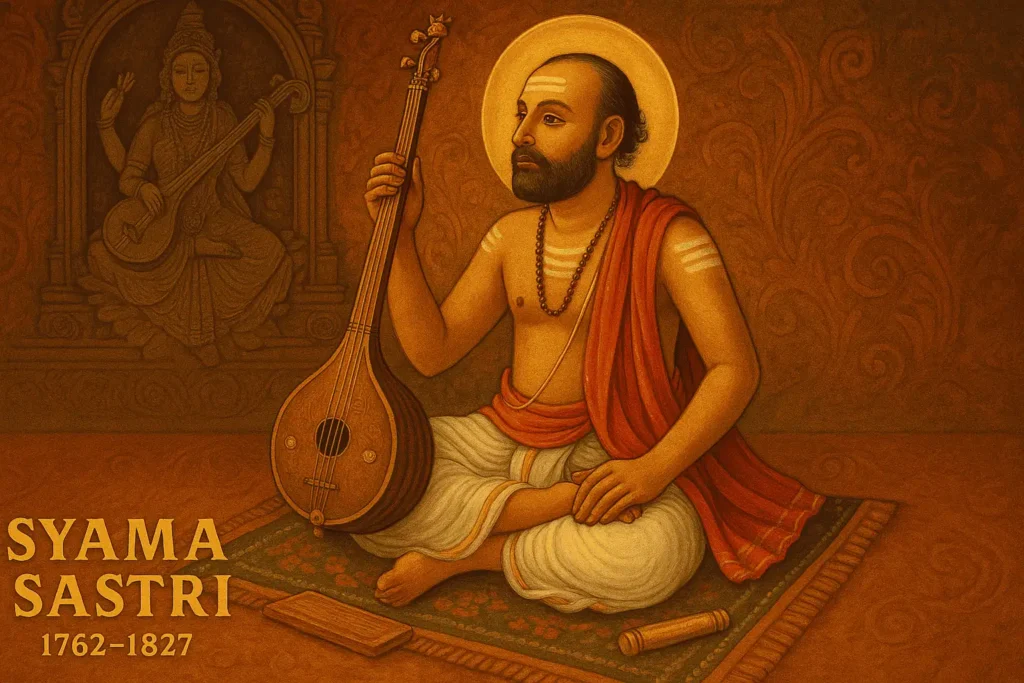
Syama Sastri (1762–1827) composed mostly in Tamil and Telugu, focusing on rhythmic complexity and emotional depth.
Style: Strong in laya, packed with bhava and devotion to Goddess Kamakshi.
Popular Kritis for Students:
- “Brova Barama” – Raga Bahudari
- “Sankari Sankuru” – Raga Saveri
- “Nanu Brovu Lalita” – Raga Lalita
- “Kanakashaila” – Raga Punnagavarali
- “Marivere Gati” – Raga Anandabhairavi
These songs train students to handle intricate talas with confidence.
How to Practise Trinity Compositions
For Singers
- Start with Tyagaraja kritis to understand expression and ease of singing.
- Use Dikshitar’s slow-paced compositions for breathwork and voice control.
- Practise tala patterns from Syama Sastri’s kritis for rhythmic accuracy.
- Record and listen to yourself to track improvement.
For Instrument Players
- Play the arohanam–avarohanam of the raga before learning the kriti.
- Break each phrase into smaller parts and practise slowly.
- Pay attention to gamakas—don’t skip them, even on instruments like keyboard.
- Use a tala app to internalise rhythm.
For Beginners at Home
- Listen to one kriti daily—children pick up patterns faster through listening.
- Use a Shruti box app to keep pitch stable.
- Start with simpler compositions like:
- “Vatapi Ganapatim”
- “Raghuvamsa Sudha”
- “Sankari Sankuru”
Common Mistakes with Trinity Compositions (and How to Avoid Them)
- Skipping gamakas → Practise slowly and clearly – Each composer uses gamakas differently—don’t flatten the notes. Practise deliberately and carefully, make sure each note is clear and distinct.
- Blending composer styles → Study their differences
- Tyagaraja = emotional
- Dikshitar = structured
- Syama Sastri = rhythmic
- Not keeping tala steady → Use a tala app consistently, especially important for Syama Sastri kritis.
- Learning only by reading lyrics → Listen to recordings
Carnatic music is transmitted orally; listening is essential.
Related Music Terms
- Raga – The melodic identity of Carnatic music.
- Tala – The rhythmic cycle creating structure.
- Kriti – A classical Carnatic composition with pallavi, anupallavi, and charanam.
- Gamaka – Ornaments that bring a raga to life.
- Shruti – The base pitch used for tuning and singing.
The Trinity—Tyagaraja, Muthuswami Dikshitar, and Syama Sastri—did more than compose songs. They created pathways for children to understand the beauty of ragas, the discipline of talas, and the joy of bhakti through music.
From my own journey, I’ve seen how classical music shapes children’s confidence, focus, and emotional balance. Even when I struggled with certain concepts as a young learner, it was the depth and beauty of these compositions that kept me curious. I later realised that children don’t always need the heavy grammar-they need the right environment to experience the magic of these songs. That is exactly why we built Music Pandit the way we did.
We introduce the Trinity’s compositions slowly, gently, and joyfully- so children not only learn them, but connect with them.
At Music Pandit, students explore Trinity kritis in our online Carnatic singing classes through:
- age-appropriate ragas
- fun activities and games
- structured lessons
- clear practice routines
- warm, child-friendly teachers
They begin to understand Carnatic music not as something difficult or intimidating, but as something beautiful and exciting.
If you want your child to truly appreciate Carnatic music in a joyful, meaningful way, they’ll experience it naturally with us through our online Carnatic music lessons.















 Chat with us