
If you’ve ever watched your child quietly slip out of a group activity, avoid play dates they once loved, or suddenly prefer spending all their time alone, you may have wondered: Is this normal?
Most parents naturally assume it’s “just shyness” or “a growing phase.” And sometimes, it is. But there are other times when these behaviours are actually early signs of social withdrawal in kids — a subtle shift that often goes unnoticed because children rarely express it directly.
Social withdrawal is more than being quiet or introverted; it’s a child’s gradual retreat from situations that once brought joy, connection, and excitement. For a parent, this can feel worrying, confusing, and even overwhelming.
The good news? When spotted early, social withdrawal can be gently addressed, and children can be guided back toward healthy social engagement with the right support.
This blog helps you understand the signs, the child psychology behind them, and practical ways to respond — all through a warm, parent-friendly lens. By the end, you’ll feel more confident in supporting your child’s emotional well-being, whether they’re 6 or 14.
Why Social Withdrawal Matters: The Child Psychology Behind It
Children flourish through connection — with parents, peers, teachers, and extended family. Social interactions shape how they develop confidence, communication skills, emotional resilience, and empathy.
But when a child begins withdrawing from these interactions, it can signal deeper concerns affecting:
- Self-esteem
- Peer relationships
- Academic engagement
- Emotional regulation
- Mental health
Why It’s Not “Just a Phase”
Kids withdrawing socially often experience internal struggles like:
- Fear of judgement
- Anxiety in unpredictable social settings
- Past negative peer experiences
- Emotional overwhelm
- Feeling misunderstood
- Lack of confidence in communication
- Fear of making mistakes
These challenges don’t simply “go away” with time. Without gentle intervention, the behaviour can become a pattern that affects their long-term emotional wellbeing.
The 6–14 Age Window
Between ages 6–14, children undergo big developmental leaps:
- Young kids (6–9 years) need belonging, predictability, and positive peer interactions.
- Older kids (10–14 years) begin forming identity, navigating friendships, and managing social pressure.
Social withdrawal during these years can disrupt healthy emotional development, which is why early identification is so important.
At Music Pandit, our teachers often observe these behavioural cues during classes. Children who quietly disengage, refuse to turn on their camera, or hesitate to participate may be struggling silently. When guided with patience, structure, and gentle encouragement, they begin to open up again.
Understanding Social Withdrawal vs Shyness
Before diving into signs, let’s clarify this crucial difference — because many parents confuse the two.
Shyness
- Temporary
- Context-based
- Child warms up gradually
- Does not stop them from enjoying social interaction once comfortable
Social Withdrawal
- Persistent
- The child actively avoids or escapes social interactions
- Even familiar people feel overwhelming to the child
- The child experiences emotional distress or discomfort
- They may prefer isolation over interaction
Unlike shyness, social withdrawal is a coping mechanism — a way for children to protect themselves from emotional discomfort they can’t yet explain.
Early Signs of Social Withdrawal in Kids
These signs often appear slowly, and parents may miss them because children don’t always articulate what they’re feeling. Below are subtle, early indicators you should watch for.
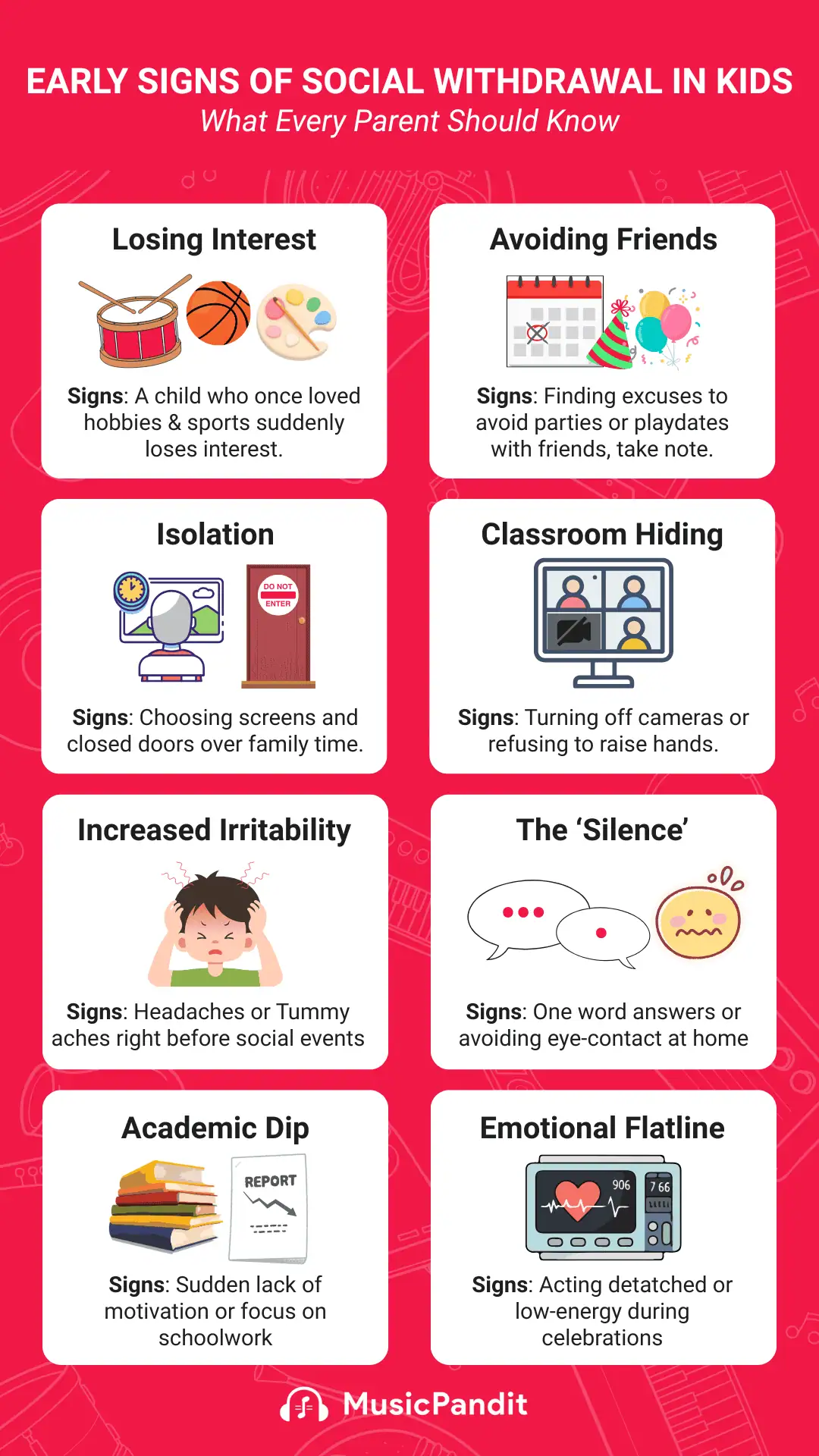
1. Reduced Interest in Activities They Once Loved
A child who once loved football, singing, group art classes, or playground games suddenly loses interest.
What it may look like:
- “I don’t want to go today.”
- “It’s boring.”
- “I don’t like it anymore.”
- “Can I skip?”
Why this matters:
Children often withdraw from activities not because of the activity itself but due to social discomfort around the group.
How parents can support:
- Don’t force participation immediately
- Explore if something happened: teasing, fear of failure, pressure
- Reintroduce the activity through a smaller, safer group
At Music Pandit, for example, children who initially avoid group singing open up when they start with one-on-one sessions or guided micro-tasks that build confidence.
2. Avoiding Friends or Playdates
If your child, who once enjoyed being around friends, begins finding excuses to avoid them, take note.
Common signs:
- Preferring to stay home during weekends
- Avoiding birthday parties
- Not initiating meet-ups
- Feeling anxious before social events
Sometimes children say, “I don’t like them anymore,” which often signals deeper discomfort.
3. Spending Excessive Time Alone
Alone time is healthy — isolation is not.
Signs of unhealthy isolation:
- Staying in their room for long stretches
- Spending most time on screens, not people
- Avoiding family conversations
- Choosing solo play even when options exist
Children do this when social settings feel unpredictable or emotionally draining.
4. Declining Participation in School or Class Activities
Teachers may notice before parents.
What teachers observe:
- Child not raising their hand
- Avoiding group projects
- Not turning on the camera during online classes
- Sitting alone during breaks
At Music Pandit, our instructors often spot early withdrawal cues such as a child eagerly starting class but slowly avoiding interactions, muting themselves often, or turning their face away from the camera. These cues help us adjust our teaching approach.
5. Increased Irritability Before Social Situations
Socially withdrawing children often show physical or emotional discomfort, such as:
- Irritability
- Sudden headaches
- Stomach aches before school
- Tearfulness
- Clinginess
These are emotional signals manifesting physically.
6. Changes in Communication Style
Children may:
- Speak less at home
- Give one-word answers
- Avoid eye contact
- Become unusually quiet
- Stop sharing about their day
Parents often say, “My child talks to everyone except me.” This silence is often a sign of inner overwhelm, not defiance.
7. Decline in Academic Performance
Kids who withdraw socially may struggle with classroom engagement, concentration, or group-based assignments.
Possible signs:
- Not submitting work
- Avoiding new tasks
- Low participation
- Reduced motivation
These are not ‘laziness’ signs; they are emotional indicators.
8. Emotional Withdrawal
Children may appear:
- Detached
- Uninterested
- Low-energy
- Disconnected from family routines
- Disengaged from celebrations or outings
This kind of emotional withdrawal is an early sign that parents must notice quickly.
Why Kids Withdraw Socially
Understanding “why” helps parents respond with empathy, not pressure.
1. Anxiety (Social, Performance, or General)
Children often retreat when they feel overwhelmed:
- Fear of embarrassment
- Uncertainty around social rules
- Pressure to perform
- Fear of making mistakes
This is common in kids aged 9–14, especially during transitions like new classes or puberty.
2. Negative Peer Interactions
Not always bullying — sometimes subtle exclusion or misunderstandings.
Examples:
- Feeling left out
- Being called “weird”
- Not being chosen in group games
- Friendship conflicts
Kids internalise these experiences deeply.
3. Low Confidence
A child who believes “I am not good at making friends” or “I am not good enough” will avoid interactions to prevent failure.
4. High Sensitivity or Introversion
Highly sensitive kids can get overwhelmed by noise, unpredictability, or group dynamics.
They’re not antisocial — they simply need gentler spaces.
5. Academic Pressure
If school feels exhausting, children may withdraw socially to conserve emotional energy.
6. Major Transitions
- Moving countries
- Changing schools
- Loss in the family
- Parental stress
- Puberty
Transitions shake emotional safety.
What Parents Often Misinterpret
Mistake 1: Calling It “Just Shyness”
Shyness warms up with time. Social withdrawal does not.
Mistake 2: Forcing Social Interactions
Pressure increases distress, making withdrawal worse.
Mistake 3: Focusing on Behaviour Instead of Emotions
“What happened?” is more powerful than “Why didn’t you go?”
Mistake 4: Comparing the Child to Others
Comparisons intensify inner shame.
Mistake 5: Assuming They’ll “Grow Out of It”
Children don’t outgrow emotional discomfort; they outgrow shame-free support.
How Parents Can Support a Socially Withdrawing Child
Here’s a step-by-step parent-friendly roadmap you can follow.
Start With Gentle Observation
Notice:
- When do they withdraw?
- With whom?
- What triggers it?
- How do they react emotionally?
Avoid labelling the behaviour prematurely.
Create an Emotion-Safe Environment
Children talk when they feel safe, not pressured.
Use phrases like:
- “I noticed you looked uncomfortable earlier. I’m here to listen.”
- “It’s okay. Take your time.”
- “You can tell me anything, and I won’t get upset.”
Warmth encourages expression.
Rebuild Confidence Through Small, Predictable Social Interactions
Start small.
Examples:
- One-on-one playdates instead of group parties
- Shorter durations
- Structured activities like baking, music lessons, or puzzles
At Music Pandit, structured online classes often help children re-engage socially at their own pace. The camera-on/camera-off flexibility, guided exercises, and supportive teachers give them gentle exposure without overwhelming them.
Encourage Creative Expression
Creative activities help children release emotions safely:
- Singing
- Art
- Music practice
- Journaling
- Storytelling
Music, especially, supports emotional regulation. Many socially withdrawn kids open up more through melody and rhythm than conversation.
Build Skills Gradually
This is key:
Withdrawn children need skill-building, not pressure-building.
Support them in:
- Conversation starters
- Conflict handling
- Assertive communication
- Emotional vocabulary
- Group participation
Be Patient With Progress
Social reconnection is slow and non-linear.
Celebrate:
- A smile
- A short conversation
- Attending class
- Responding in a group task
Small steps matter.
What Progress Looks Like (Realistic Signs)
Parents should expect:
- More willingness to participate
- Opening up at home
- Accepting invitations occasionally
- Improved mood
- Increased energy
- Curiosity returning
- Enjoying small social moments
At Music Pandit, we see children bloom gradually. A child who once refused to sing on camera may one day unmute confidently or even volunteer for a small solo — a huge emotional milestone.
Indicators That You May Need Additional Support
You may consider speaking with a child counsellor if your child shows:
- Persistent withdrawal for 3+ months
- Avoidance of school
- Sudden drop in academic performance
- Intense fear of peers
- Complete refusal of social activities
- Emotional shutdown
- Self-critical statements
- Noticeable mood changes
Early support can make a big difference.
Conclusion
Every child deserves to feel understood, supported, and emotionally safe. If you’ve noticed early signs of social withdrawal in your child, remember — it isn’t a reflection of your parenting, nor does it mean your child is “difficult.” It simply means they’re navigating emotions they don’t yet have the words for.
For over 15 years, I’ve worked with children across different ages, personalities, and learning styles. One thing I’ve learned is that kids rarely say, “I’m struggling.” Instead, they show us through small shifts in behaviour — quieter moments, hesitations, or a sudden need for space. My work as an educator has helped me recognise these early cues and guide families with practical, compassionate strategies. I share this guidance with you not just as a professional, but as someone who has walked alongside many children through similar challenges.
With patience, gentle structure, and nurturing environments, children gradually rediscover confidence, connection, and joy. Structured, child-friendly activities — like music, expressive arts, or supportive small-group learning — often help them open up at their own pace. At Music Pandit, we’ve seen children who once hesitated to engage slowly blossom through encouraging, interactive experiences.
With the right approach, your child can, too — one warm conversation, one tiny step, one hopeful moment at a time. You’re not alone in this journey, and your child is capable of more connection and confidence than you can imagine.
















 Chat with us