
Children often struggle to express their emotions, and there are clear reasons behind it.
Their brains are still developing, especially the part that helps them control and understand their feelings.
Because of this, kids may not always know how to manage big emotions on their own.
You might have noticed your child coming home from school in tears without being able to explain the reason. As a parent, you may wonder what went wrong.
In this situation, it’s important to understand that many children have a limited emotional vocabulary.
They may feel something strongly but not know the right words to describe it.
When emotions become intense, kids can easily feel overwhelmed.
Sometimes, they stay silent because they fear negative reactions from adults or don’t feel safe enough to share openly.
Here, this is an awareness message about understanding the emotional struggles of kids.
So, this will help you stop shouting the next time your child cries or throws a tantrum for unknown reasons.
Shall we delve into the topic?
Why Many Kids Struggle to Express Their Emotions
Have you ever wondered why kids struggle to express their emotions?
The part of the brain that helps children control their emotions is called the prefrontal cortex. It acts like a “control center,” helping kids pause, think, and manage strong feelings like anger, fear, or frustration.
Other areas, like the amygdala, react quickly to emotions, especially strong or sudden ones. Since these parts are still growing, children often react with feelings first, and words come later.
Research shows that children between about 4 and 11 years old gradually learn more words for feelings. As they grow, they understand and use words like “frustrated,” “nervous,” or “excited.”
Children who practice naming emotions early through everyday talk, caregiver support, and guided discussion develop better emotion regulation skills. This means they can handle strong feelings more calmly and express them clearly.
So, let’s look at the real reasons behind this struggle and how we can help children healthily express their emotions.
1. Their Brains Are Still Learning Emotional Skills
Children often feel emotions very strongly, but their brains aren’t fully ready to handle them. The part of the brain that helps control impulses and think before acting; the prefrontal cortex develops slowly. This means kids often react with feelings instead of words.
They also don’t always have the right words to explain what they feel.
For example, a 5-year-old might hit a sibling when upset, not because they want to hurt them, but because they don’t know how to say, “I feel angry” or “I’m frustrated.”
Research from the Harvard Center on the Developing Child shows that children’s ability to regulate emotions improves with practice, guidance, and a safe environment.
When adults stay patient, listen, and help label feelings, kids gradually learn to manage their emotions better.
2. Kids Don’t Have the Words They Need
At the start of the academic year, many young children cry or refuse to get ready for school, especially those going for the first time.
They might say, “I don’t want to go!” or “I hate school!” But the real feeling behind these words is anxiety.
They feel scared because they are separating from their family for the first time, and they worry about being in a new place with new faces.
They don’t know how to say, “I feel nervous,” or “I’m scared to be away from you.
Instead of blaming the child, a parent can stay calm and gently name the child’s feelings. You can say,
“It looks like you feel scared because school is new. It’s okay to feel this way. I’m proud of you for trying.”
You can also offer comfort by explaining what will happen at school, showing pictures of the classroom, meeting the teacher early, or creating a short goodbye routine.
These small steps help the child feel safe and supported, and they slowly build confidence in the new environment.
3. Fear of Being Misunderstood or Judged
When a child finally starts to open up, parents often interrupt and try to correct the story right away. This might come from a good intention, but it creates a negative impact.
The child feels judged, not heard. They start thinking, “If I say something wrong, my parents will get upset or correct me.” So next time, they choose to stay quiet and keep everything to themselves; even when they need help.
That’s why it’s so important for parents to listen without interrupting. When you stay calm, let them talk, and show that you won’t judge them, children feel safe to share their real feelings.
4. Overstimulation From Screens & Busy Routines
Early exposure to gadgets or screen time for children can affect them.
Kids can get overstimulated when there’s too much happening like bright screens, loud sounds, or a packed routine. It’s not about screens being bad; it’s simply too much input for their brains at once.
When overwhelmed, kids may get upset or shut down because they can’t process their feelings. Short breaks and calm moments help them reset and express themselves better.
5. Children Express Through Behaviour, Not Words
Kids don’t always use words to show their feelings. Instead, their behaviour becomes the voice of their emotions. When they don’t know how to say what’s happening inside, their actions reveal the truth.
Here are common examples parents often see:
- Tantrums = frustration
Your child may scream, cry, or throw things when they feel stuck, overwhelmed, or unable to express what’s bothering them. - Silence = stress
A suddenly quiet child may feel worried or tense but doesn’t know how to explain their feelings. - Clinginess = insecurity
When a child refuses to leave your side, it often means they need extra comfort or reassurance.
Understanding these behaviour cues helps parents respond with empathy instead of frustration. When you see the emotion behind the behaviour, you can support your child more effectively.
Signs Your Child May Be Struggling to Express Emotions
- They avoid conversations or change the topic quickly.
- They get irritated or upset over small things.
- They say “I don’t know” when you ask how they feel.
- They withdraw and prefer to stay alone.
- They complain of stomach aches or discomfort when they feel stressed.
These signs simply show that your child may need extra support, patience, and a safe space to share their feelings.
How Parents Can Help at Home (Simple & Practical)
1. Label Emotions for Them
When you notice your child seems upset, name what you see.
When your child gets upset after a game, try asking, ‘Are you upset because the game didn’t go how you wanted?
This helps them connect what they feel inside with a word and that gives them a start to explain. Research also says children who learn emotional words early develop stronger emotional awareness.
2. Validate First, Correct Later
Start by showing you understand, before giving solutions or correcting anything.
Say something like: “It’s okay to feel angry or sad. Everyone feels that sometimes.”
Let them know their emotions are real and welcome. This strategy, often called “emotion coaching,” helps children regulate their emotions better over time.
3. Use Check-In Questions
Make small check-ins part of your daily routine. Ask simple, open questions such as: “What was the happiest part of your day?” “What felt uncomfortable today?”
These questions give kids a chance to think about their feelings and share without pressure. Over time, regular check-ins help children become more comfortable opening up.
4. Use Play, Drawing, or Stories to Help Expression
Kids often express feelings best through activity rather than direct talk. Offer them tools like drawing, pretend play, or storytelling.
Let them draw how their day felt. Use puppets or toys to act out a story.
These activities give children a safe, creative way to show what’s inside when they don’t yet have the words, and research shows that art and play help children process emotions and communicate better.
5. Model Emotional Expression
Children learn a lot by watching adults. Show them it’s okay to express feelings in healthy ways.
Use simple statements like, “I felt disappointed today, so I took a deep breath and walked away.”
Let them see you handling emotions calmly and openly.
Studies show that when parents express both positive and negative emotions in healthy, controlled ways, children learn good emotional regulation skills by example.
How Creative Activities Help Kids Express Emotions
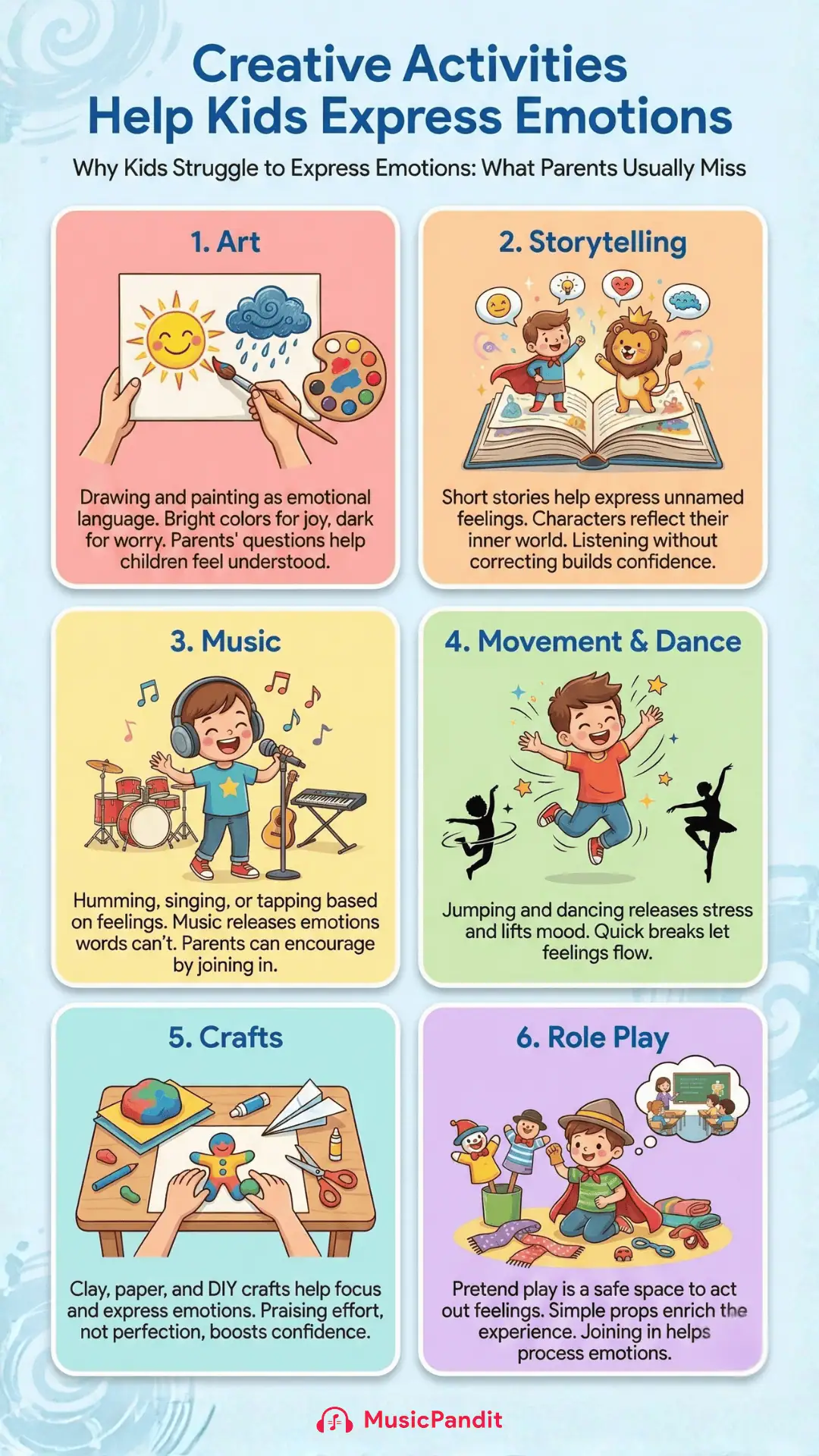
Kids feel many emotions every day, but they don’t always have the words to explain them. Creative activities give them a simple, natural way to express what’s inside.
Art
Drawing and painting become a child’s emotional language—bright colours for joy, darker tones for worry. When parents ask, “Tell me about your picture?”, children feel understood and supported.
Storytelling
Short stories help kids express feelings they can’t name. A lonely bird or a brave hero often reflects their inner world. Listening without correcting builds emotional confidence.
Music
Kids hum, sing, or tap rhythms based on how they feel. Music helps them release emotions that words can’t capture. Parents can encourage this by playing different tunes and joining in.
Movement & Dance
Jumping, spinning, or dancing allows kids to release stress and lift their mood. Quick movement breaks remind them it’s okay to let feelings flow.
Crafts
Clay, paper, and simple DIY crafts help children focus and express emotions through hands-on creation. Praising effort—not perfection—boosts confidence.
Role Play
Pretend play gives kids a safe space to act out feelings. A child worried about school may pretend to be a teacher. Simple props like scarves, puppets, or small toys make the experience even richer. Joining their play helps them process emotions gently.
Simple Music-Based Activities Parents Can Try at Home
Music impacts the brain and emotions by activating areas that create pleasure and reward. According to Harvard Medical School Magazine, this releases chemicals like dopamine, which lift mood and make us feel good.
Music also engages many parts of the brain that process emotions, memory, and senses. Slow, gentle songs can evoke calm or nostalgia, while fast, upbeat music can make children feel happy and energetic.
Here are some simple music activities you can try at home for your kids.
Create a “feelings playlist.”- Make a playlist with songs for different moods — happy, calm, sad, or relaxed. Play it when your child needs help calming down or sorting through feelings.
Hum together softly- Sit with your child and hum a gentle tune. Soft humming or singing can calm their nervous system and help them relax when emotions feel strong.
Tap or clap simple rhythms- When your child feels upset or anxious, try tapping or clapping a slow, steady rhythm together. This helps them slow down, breathe, and feel less overwhelmed.
Sing mood-based songs- Pick songs that match your child’s feelings — a cheerful song when they’re happy, a calm lullaby if they feel anxious, or a gentle song when they’re sad. Singing helps them express feelings they don’t yet have words for.
Recently, I read a book written by Shabeeda P. In the book, she shares a strong and touching story about a child with ADHD. This child found it hard to stay calm and focused. Many usual methods did not help. But something unexpected did — music.
She explains how music helped the child slow down, breathe better, and feel more in control. A simple rhythm or a familiar tune worked like an anchor. When the child listened to music or joined a small music activity, the restlessness went down. The child became calmer, more settled, and more ready to learn.
When to Consider Professional Support
Sometimes children need more support than we can provide at home, and that is completely normal. Here are some gentle signs that professional help might benefit your child:
- You notice a persistent emotional shutdown. For weeks, your child may seem quiet, withdrawn, or emotionally checked out.
- Your child avoids all questions about feelings, even simple ones like how their day went. They may refuse to answer or freeze when you try to talk.
- Their behaviour affects friendships, school, and daily life. They may avoid friends, struggle at school, or lose interest in activities they once enjoyed.
If these signs continue for some time, seeking professional support can be a caring and helpful choice.
The Indian government provides many free counseling services. You can call the Tele MANAS helpline (14416 or 1800-89-14416) anytime for mental health support.
Students can also get help through the Manodarpan program. NIMHANS and the National Health Mission (DMHP) offer support for different groups.
These services give tele-counseling, crisis help, and mental-wellness resources in many languages across the country.
You can consider the Vandrevala Foundation for professional support. They are very good at what they do. I’m just sharing my experience.
Always remember, getting help does not mean there is a serious problem. It can guide your child in building emotional skills and confidence.
Conclusion
Parenting is challenging, and you are doing your best.
Emotional expression is a skill that grows slowly. With your support, patience, and safe outlets like creative play or music, children learn to understand and share their feelings.
You do not need to get it right every day. What matters most is love, consistency, and a gentle willingness to listen. With care and time, your child can learn to express emotions clearly and thrive both emotionally and socially.










 Chat with us