
Raag Samay Chakra is a traditional system in Hindustani classical music that connects specific raags to particular times of the day.
It helps musicians choose and perform raags at the time when they sound most pleasant, balanced, and emotionally effective.
What is Raag Samay Chakra in Hindustani Music?
Raag Samay Chakra is a time-based framework used in Hindustani music. It divides the full 24 hours of a day into different time zones, with certain raags assigned to each zone. The idea is that music feels more natural and expressive when played at the right time.
For example, calm and peaceful raags are usually sung early in the morning, while serious or deep raags are performed in the evening. This system has been followed for centuries and is still taught to students of Indian classical music today.
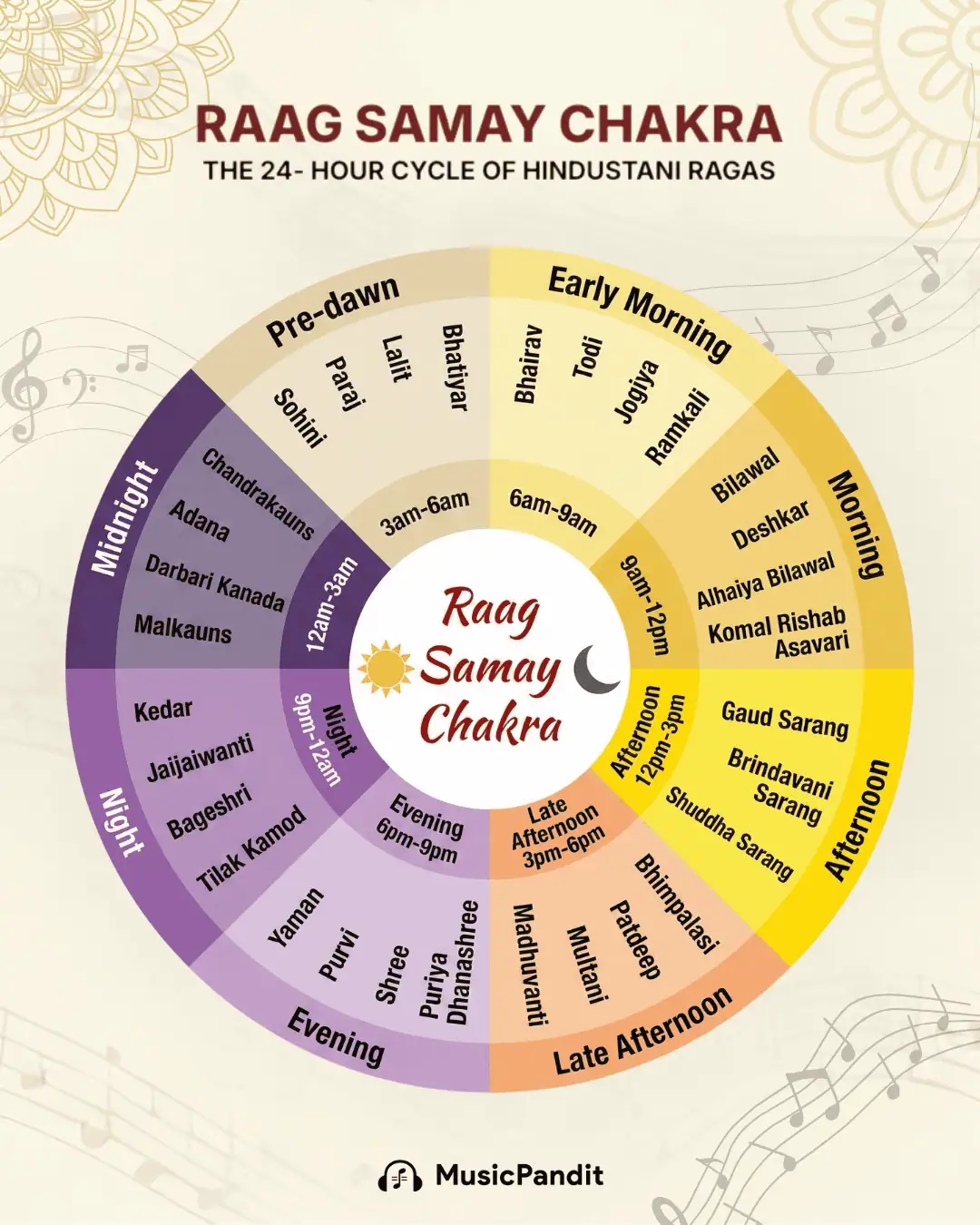
Why is Raag Samay Chakra Important?
- Enhances emotional impact – Raags sound more powerful and meaningful when sung at their correct time.
- Helps children understand mood in music – Students learn how music can reflect different feelings throughout the day.
- Improves raag selection – Musicians know which raag to practise or perform at a given time.
- Builds discipline and structure – Children learn that music follows rules and thoughtful systems.
- Connects music with nature – Teaches how sound, time, and human emotions are linked.
Elements of Raag Samay Chakra
Time of the Day (Prahar System)
The day is traditionally divided into eight parts, called prahars. Each prahar is around three hours long and has a specific emotional quality.
Example: Early morning prahars are calm and fresh, while evening prahars feel serious or romantic.
Aaroh Notes (Ascending Notes)
The time of a raag is often decided by the type of notes used while going up the scale (aaroh).
Example: Raags with flat notes (komal swaras) are usually sung in the evening or night.
Mood (Rasa)
Each time of day has a natural mood, and ragas performed at that time reflect it.
Example: Morning raags often feel peaceful or spiritual, while night raags can feel deep or introspective.
Natural Energy of the Listener
Raag Samay Chakra also considers how alert or relaxed people usually feel at different times of the day.
Example: Slow, soothing raags suit early mornings when the mind is calm.
Common Time Zones and Raags
Early Morning Raags (4 am – 7 am)
These raags feel soft, calm, and prayer-like.
Examples: Raag Bhairav, Raag Lalit
Morning Raags (7 am – 10 am)
These raags sound bright and fresh.
Examples: Raag Bilawal, Raag Deshkar
Afternoon Raags (12 pm – 4 pm)
These raags are steady and thoughtful.
Examples: Raag Multani, Raag Bhimpalasi
Evening Raags (4 pm – 7 pm)
These raags feel warm and emotional.
Examples: Raag Yaman, Raag Marwa
Night Raags (7 pm – 12 am)
These raags are deep, romantic, or serious.
Examples: Raag Kafi, Raag Khamaj
Late Night Raags (12 am – 4 am)
These raags feel introspective and peaceful.
Examples: Raag Darbari Kanada, Raag Malkauns
How to Practise Raag Samay Chakra
For Beginners at Home
- Learn which raag belongs to which time using simple charts.
- Listen to one raag in the morning and one at night daily.
- Talk about how the music feels—calm, bright, serious, or deep.
- Parents can help children match raags with daily routines like waking up or bedtime.
For Singers
- Practise raags at their correct time whenever possible.
- Start with slow alaap to feel the mood of the raag.
- Notice how your voice feels different in the morning and evening.
- Listen to recordings of senior musicians performing raags at the right time.
For Instrument Players
- Play raag phrases during the correct time of day.
- Focus on aaroh and avaroh patterns to understand time placement.
- Use tanpura or drone notes to create the right atmosphere.
- Compare the same raag played at different times to hear the difference.
Mistakes to Avoid with Raag Samay Chakra
- Ignoring time completely → Start by at least listening to raags at the correct time.
- Memorising without understanding mood → Always connect raag with feeling.
- Confusing similar raags → Learn their time placement to tell them apart.
- Overthinking strict rules → Understand the system first; flexibility comes later.
- Skipping listening practice → Regular listening builds natural understanding.
Related Music Terms
- Raag – A structured set of musical notes used for melody.
- Alaap – Slow, free exploration of a raag.
- Prahar – A three-hour division of time in Indian music.
- Swaras – Musical notes in Indian classical music.
- Rasa – The emotion or mood created by music.
Learn Hindustani Music with Music Pandit.
At Music Pandit, children learn Hindustani music in a way that feels natural and joyful. Concepts like Raag Samay Chakra are taught through listening, guided practice, and simple explanations- never through memorisation alone. Our structured lessons, friendly teachers, and regular feedback help children understand why music works the way it does, not just how to sing or play it.
















 Chat with us