
A bandish (बंदिश) is a fixed musical composition in Hindustani classical music, set in a particular raga and a particular taal, and usually carrying lyrics. It gives a singer a fixed structure to perform while leaving room for improvisation around it.
(The word also names several Hindi films. This article is about the musical form.)
A Bandish is one of the most important parts of learning Hindustani classical music. It helps students understand how a raga comes alive through a complete musical composition.
Think of a Bandish as the framework of a musical performance. The notes, words and rhythm provide structure, while the singer adds expression and creativity.
For young learners, practising Bandish develops musical understanding, pitch accuracy, rhythmic awareness and confidence.
What Is Bandish in Hindustani Music?
In Hindustani classical music, a Bandish is a composed melody set within a particular raga and taal.
The word Bandish comes from the Hindi word bandhna, meaning “to bind” or “to tie together”. This describes how musical notes, rhythm and lyrics are organised into a composition.
Unlike a song that is usually performed in a largely fixed manner, a Bandish allows considerable freedom for musical improvisation.
For example, when a student learns a Bandish in Raga Yaman, they learn a melody that follows Yaman’s musical rules. As their skills improve, they can develop the performance through variations, note patterns and expressive phrases.
A Bandish usually contains three essential elements:
- Raga: The melodic framework that determines which notes and phrases are used.
- Taal: The rhythmic cycle that organises the composition into repeating beats.
- Lyrics: The words that carry meaning and support musical expression.
Some compositions are performed without lyrics, particularly instrumental compositions. However, the term Bandish is most commonly associated with vocal music.
Older teachers sometimes call a composition a cheez (चीज़, literally “a thing” or “an item”). It means the same as bandish, and you may hear both words in the same class.
Why Is Bandish Important in Hindustani Classical Music?
Learning Bandish helps students move beyond practising individual notes towards understanding complete musical compositions.
Here are five important benefits.
- Develops raga understanding: A Bandish introduces characteristic phrases and movements that establish a raga’s identity.
- Improves rhythmic accuracy: Singing within a taal helps students recognise beats, rhythmic cycles and important accents.
- Encourages musical expression: Lyrics and melodic phrases teach students to communicate feelings through singing.
- Builds improvisation skills: A familiar composition provides a foundation for exploring new musical ideas.
- Strengthens musical memory: Remembering melodies, lyrics and rhythmic patterns develops concentration and listening skills.
For children, learning a Bandish is also an important milestone. It allows them to perform a complete piece rather than only singing exercises.
Main Elements of a Bandish
A Bandish is carefully organised so that its melody, rhythm and words work together.
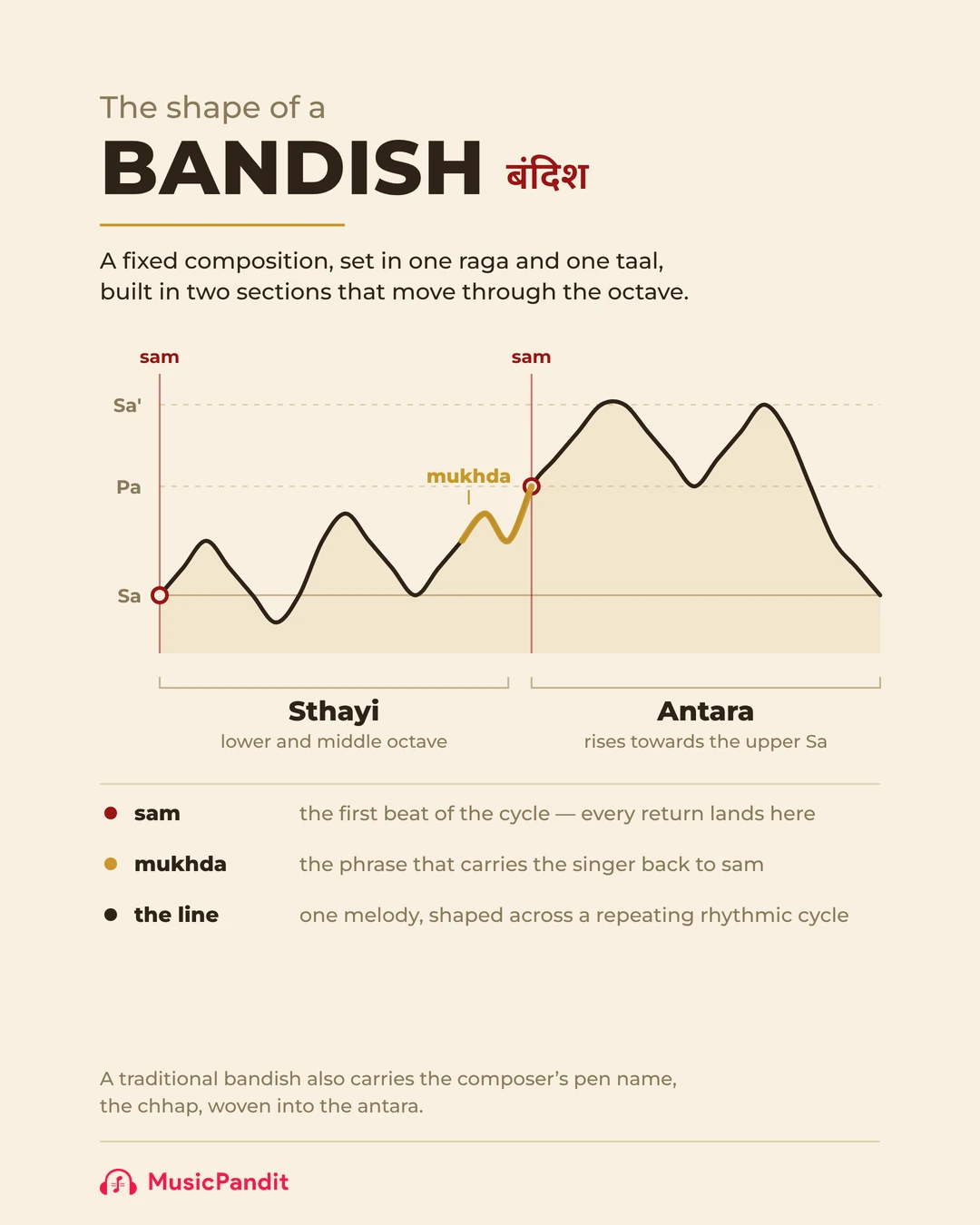
Two important sections are the Sthayi and Antara.
1. Sthayi – The Opening Section
The Sthayi (स्थायी) is the first section of a Bandish.
It usually explores the lower and middle registers of the raga and establishes the composition’s main melodic identity.
The Sthayi is especially important because singers repeatedly return to it during a performance.
It often contains the mukhda (मुखड़ा), a recognisable opening phrase that helps the performer return to the sam, the first beat of the taal cycle.
For example, a student learning a Bandish in Raga Bhairav may first practise the Sthayi until its melody and rhythmic placement become comfortable.
Once the student understands this section, the teacher can introduce simple variations.
2. Antara – The Higher Melodic Section
The Antara (अंतरा) is the second main section of a Bandish.
It generally explores higher notes, often moving towards the upper Sa.
This creates a natural contrast with the Sthayi and allows the composition to develop melodically.
The Antara also gives students opportunities to practise moving smoothly between different vocal registers.
For example, a Bandish in Raga Yaman might begin with phrases in the middle register. Its Antara may rise towards the upper Sa before returning to the familiar melodic material.
Sthayi vs Antara in Bandish
| Feature | Sthayi | Antara |
|---|---|---|
| Position | First section | Second section |
| Main register | Lower and middle | Middle and upper |
| Purpose | Establishes the composition | Expands the melody |
| Musical movement | Often stays near the main melodic phrases | Often rises towards higher notes |
| Performance role | Frequently revisited | Provides contrast and development |
Both sections are important for understanding the complete musical structure.
Some traditional compositions contain additional sections. Dhrupad compositions in particular may add a Sanchari (संचारी), which moves between registers and develops the material further, and an Abhog (आभोग), which concludes the composition and often carries the composer’s name. In Khayal, Sthayi and Antara are by far the most common.
What Is the Mukhda?
The mukhda is the short phrase at the head of the Sthayi that leads back into sam.
It matters more than its length suggests. During a performance a singer leaves the composition to improvise, and the mukhda is how they get back: it is picked up a beat or two before the cycle turns, and it lands exactly on beat one. Teachers often drill the mukhda on its own before the rest of the composition, because a student who cannot find sam cannot perform a bandish at all.
The Chhap: The Composer’s Signature
One feature sets a traditional bandish apart from an ordinary song: the composer signs it from inside the lyrics.
This signature is called the chhap (छाप) or mudra (मुद्रा). The composer’s pen name is woven into the words of the Antara, so the attribution travels with the music itself rather than on a title page.
The best-known names in the Khayal repertoire are Sadarang and Adarang, pen names associated with the eighteenth-century court musician Niyamat Khan and his relative Firoz Khan, and Manrang. Hundreds of compositions still taught today carry one of these names in the Antara.
This is why a bandish is not anonymous folk material and not a modern song. It is a signed work of poetry and music that has been handed down, teacher to student, for centuries — and it is one of the reasons students are taught to sing the words clearly rather than treat them as sounds.
Types of Bandish in Hindustani Music
Bandishes can be classified according to their musical form, tempo and performance style.
Khayal Bandish: Bada and Chhota
Most Bandishes a student meets belong to Khayal, the major vocal form of Hindustani classical music.
A Bada Khayal is a large composition performed in a slow tempo (vilambit laya), which gives the singer space to develop the raga gradually. A Chhota Khayal is shorter and performed in a medium or fast tempo (drut laya), with a more compact melody and livelier improvisation. Students usually learn a Chhota Khayal first.
For how these two forms are performed, how a Khayal concert is structured and how the gharanas differ in their approach, see our full guide to Khayal in Hindustani Music.
Dhrupad Bandish
Dhrupad is an older classical vocal form with a highly structured approach to melody and rhythm.
Its compositions often use serious, devotional or philosophical themes.
Traditional Dhrupad compositions may contain four sections: Sthayi, Antara, Sanchari and Abhog.
Dhrupad performances place considerable emphasis on voice production, precise intonation and rhythmic development.
Example: a traditional Dhrupad composition in Raga Bhairav, performed with Pakhawaj accompaniment.
Tarana
Tarana is a vocal composition that uses rhythmic syllables rather than conventional poetic lyrics.
These may include sounds such as tanana, dere na and yalali.
Tarana compositions are often performed at medium or fast tempos, although slower examples also exist.
They help singers develop clarity, agility and rhythmic coordination.
Example: a Tarana in Raga Yaman, performed in Teentaal.
Gat: The Instrumental Equivalent
On an instrument, the composed piece is usually called a gat rather than a bandish.
A gat serves the same purpose — a fixed composition in a raga, set to a taal, used as the base for improvisation — but it has no lyrics, so its identity rests entirely on the melodic phrase and the stroke patterns used to play it.
Comparison of Bandish Types
| Type | Typical tempo | Key feature | Example |
|---|---|---|---|
| Bada Khayal | Slow (vilambit) | Detailed raga development | Raga Yaman in Ektaal |
| Chhota Khayal | Medium or fast (drut) | Compact composition, lively improvisation | Raga Bhupali in Teentaal |
| Dhrupad | Varies | Four sections, measured development | Raga Bhairav with Pakhawaj |
| Tarana | Often medium or fast | Rhythmic syllables and vocal agility | Raga Yaman in Teentaal |
| Gat | Varies | Instrumental, no lyrics | Sitar gat in Teentaal |
These categories describe common performance practices rather than rigid rules. Individual compositions may differ across musical traditions and gharanas.
How Does a Bandish Work With Raga and Taal?
A Bandish connects the melodic rules of a raga with the rhythmic structure of a taal.
Understanding this relationship is essential for learning Hindustani classical music.
The Role of Raga
A raga provides the melodic identity of a Bandish.
It determines the notes, characteristic movements and important phrases used in the composition.
For example, Raga Bhupali uses five swaras:
Sa – Re – Ga – Pa – Dha – Sa
Ma and Ni are omitted in its standard form.
A Bandish in Bhupali uses the raga’s characteristic melodic movements to create a recognisable musical identity.
Students must learn these movements rather than simply memorising the notes.
The Role of Taal
Taal provides the rhythmic framework of a Bandish.
A common example is Teentaal, which contains 16 beats arranged into four groups of four. The first beat is sam. The ninth beat is khali, marked by a wave instead of a clap.
When singing a Bandish in Teentaal, students learn to position the melody correctly within this cycle.
The melody may begin before, on or after the sam, depending on the composition.
Recognising the sam helps singers return to the correct point after improvisation.
Shorter cycles work the same way. A light composition set to Dadra Taal has only six beats to work with, so its mukhda is correspondingly brief; a Bada Khayal in Ektaal has twelve slow beats and far more room.
Bandish vs Raga: What Is the Difference?
Students sometimes confuse a Bandish with a raga because both are closely connected.
However, they serve different purposes.
| Feature | Raga | Bandish |
|---|---|---|
| Meaning | A melodic framework | A composed musical piece |
| Structure | Rules and characteristic phrases | A recognisable melody, often with lyrics |
| Rhythm | Not necessarily tied to one taal | Usually set to a particular taal |
| Creativity | Supports many possible melodies | Provides a base for improvisation |
| Example | Raga Yaman | A Khayal Bandish composed in Raga Yaman |
A useful comparison is language and poetry.
A raga is like a language with its own vocabulary and rules. A Bandish is like a poem written using that language.
Many different Bandishes can be composed within the same raga.
How to Practise Bandish at Home
Learning a Bandish becomes easier when students divide it into smaller, manageable sections.
A few minutes of focused daily practice can make a meaningful difference.
For Beginners at Home
- Listen carefully: Play the Bandish twice and identify where the melody repeats.
- Learn the Sthayi: Practise one short phrase at a time before combining phrases.
- Count the beats: Clap the taal slowly while listening to the composition.
- Add the lyrics: Sing the words clearly without rushing the melody.
- Repeat daily: Spend five to ten minutes reviewing the composition.
Parents can support younger children by encouraging regular practice without expecting immediate perfection.
For Singers
- Begin with a tanpura or suitable drone to establish the correct reference pitch.
- Sing the Sthayi slowly, paying attention to swaras and characteristic raga phrases.
- Practise the Antara separately, especially movements towards higher notes.
- Practise the mukhda on its own until you can land on sam without counting.
- Use tabla accompaniment or a taal app to strengthen rhythmic placement.
- Introduce simple improvisations only after learning the original composition accurately.
Students should avoid increasing speed before they can sing the melody comfortably.
For Instrument Players
Instrumental students may learn composed pieces called gats, which serve a related purpose.
- Identify the raga and rhythmic cycle of the composition.
- Practise the main melodic phrase slowly.
- Use a metronome or tabla app to maintain a steady pulse.
- Connect melodic phrases without losing their rhythmic placement.
- Explore simple variations while preserving the raga’s identity.
Instrumental compositions may follow different structures depending on the instrument and musical tradition.
Common Mistakes While Learning Bandish
Beginners often concentrate on remembering the tune while overlooking important musical details.
Here are five common mistakes and practical solutions.
- Memorising without understanding the raga → Learn its important swaras and characteristic phrases before practising the full composition.
- Losing track of the taal → Clap the rhythmic cycle slowly and identify the sam before singing.
- Rushing through difficult phrases → Reduce the speed and practise short sections until they become comfortable.
- Ignoring pronunciation → Speak the lyrics clearly before adding the melody. The words carry the composer’s signature, so they are not filler.
- Improvising too early → Learn the original Bandish accurately before introducing variations.
Teachers can help students correct these mistakes through demonstration, repetition and constructive feedback.
The Role of Bandish in Musical Improvisation
One of the most interesting features of Hindustani classical music is its balance between composition and improvisation.
A Bandish provides the foundation, while improvisation allows singers to develop their musical ideas.
Three common techniques are particularly important.
Alaap
Alaap is the gradual exploration of a raga through melodic phrases.
In Khayal performances, singers may develop the raga around the Bandish using slower, expressive phrases.
This helps listeners recognise the raga’s distinctive musical character.
Bol Alaap
Bol Alaap uses words from the Bandish to create melodic variations.
Instead of introducing entirely new lyrics, singers stretch or rearrange musical phrases using the existing words.
This technique combines lyrical expression with melodic creativity.
Taan
Taan refers to faster melodic passages using swaras and characteristic raga movements.
Taans require accurate pitch, breath control and rhythmic coordination.
Students usually begin with simple patterns, often built from the alankar exercises they already know, before attempting longer and faster passages.
These improvisational techniques demonstrate why learning a Bandish involves much more than memorising a song.
Bandish in Different Gharanas
A gharana is a musical lineage or school associated with particular teaching and performance traditions.
Different gharanas may approach the same Bandish in distinctive ways.
For example, the Gwalior gharana is widely associated with clear composition-based presentation and balanced melodic development.
The Kirana gharana is especially known for its attention to swara, intonation and gradual melodic elaboration.
The Agra gharana is recognised for its strong rhythmic approach and distinctive forms of melodic development.
These descriptions are broad characteristics rather than strict rules.
A composition may also be passed between gharanas, with differences in ornamentation, phrasing and presentation.
This variety is an important part of the richness of Hindustani classical music.
Frequently Asked Questions About Bandish
1. What is Bandish in Hindustani classical music?
A Bandish is a fixed musical composition based on a particular raga and usually set to a taal. It commonly includes lyrics and a recognisable melody. Singers use it as the foundation for performing and developing a raga through techniques such as Alaap, Bol Alaap and Taan.
2. How many types of Bandish are there?
There is no single fixed number of Bandish types. In Khayal, Bada Khayal and Chhota Khayal are two important categories. Composed forms such as Dhrupad and Tarana are also studied alongside them. Bandishes can additionally be described by their tempo, taal, raga and performance tradition.
3. What is the difference between Bandish and Khayal?
Bandish refers to a composed musical piece, while Khayal is a major vocal performance form in Hindustani classical music. A Khayal performance typically uses a Bandish as its foundation. The singer develops the raga through melodic improvisation, rhythmic variations and expressive interpretation of the composition.
4. What is the difference between Sthayi and Antara in Bandish?
Sthayi is the opening section that establishes the composition’s main melodic identity. It usually focuses on the lower and middle registers. Antara is the following section, often exploring higher notes. Together, they create a balanced musical structure and help singers develop their understanding of a raga.
5. What is the mukhda in a Bandish?
The mukhda is the short phrase at the head of the Sthayi that leads back to sam, the first beat of the taal cycle. Singers use it to return to the composition after improvising. Because it is the point where melody and rhythm meet, teachers often ask students to practise the mukhda on its own.
6. What is the chhap in a Bandish?
The chhap, also called the mudra, is the composer’s pen name woven into the lyrics of the Antara. It is how a traditional composition is signed from inside the music rather than on a title page. Sadarang, Adarang and Manrang are among the names most often found in the Khayal repertoire.
7. Can beginners learn Bandish in Hindustani music?
Yes, beginners can learn simple Bandishes after developing basic familiarity with swaras, pitch and rhythm. Teachers often introduce short compositions in accessible ragas. Students gradually learn the Sthayi, Antara and taal before attempting improvisation. Regular guided practice helps them build accuracy, confidence and musical understanding.
Related Music Terms
- Raga in Music — a melodic framework that guides how musical notes are organised and expressed.
- Khayal in Hindustani Music — a classical vocal form that combines composed melodies with improvisation.
- Taal and Laya in Indian Music — the rhythmic cycle that organises a composition, and the tempo at which it moves.
- Alankar in Music — patterns of swaras used to develop pitch accuracy, technique and fluency.
- Gharana in Hindustani Music — a musical lineage with distinctive teaching and performance traditions.
- Ektaal in Hindustani Music — a 12-beat rhythmic cycle commonly used in Hindustani classical compositions.
- Raga Bhairav in Hindustani Music — a traditional morning raga known for its serious, contemplative character.
Want Your Child to Understand Bandish Beyond Memorising Songs?
At Music Pandit, we believe children should understand the music behind every composition, not simply memorise melodies. Through our online Hindustani vocal classes, your child will learn Bandish through structured lessons, engaging practice and personalised teacher feedback.












 Chat with us