
Dadra Taal (also written as Dadra Tal; दादरा ताल) is a six-beat rhythmic cycle used in Hindustani classical music, especially in light-classical music, ghazals, bhajans and folk-inspired songs. Its beats are divided into two groups of three, creating a gentle, flowing rhythm that is easy to recognise and enjoyable to practise. Dadra Taal is one of the first rhythmic patterns many young music students learn. Its simple structure helps children understand how beats repeat and how rhythm supports a melody.
What Is Dadra Taal in Hindustani Music?
Dadra Taal is a rhythmic cycle containing six beats, known as matras (मात्रा). These beats repeat in a fixed pattern throughout a musical performance. In Hindustani classical music, a rhythmic cycle is called a taal. It provides a structure that helps singers and instrumentalists stay together. Dadra Taal has two sections, called vibhags (विभाग). Each section contains three beats. The structure is:
| Beat 1 | Beat 2 | Beat 3 | Beat 4 | Beat 5 | Beat 6 | |
|---|---|---|---|---|---|---|
| Vibhag | First vibhag | Second vibhag | ||||
| Sign | X (taali) | 0 (khali) | ||||
| Hand | Clap | — | — | Wave | — | — |
1 2 3 | 4 5 6 | 1 2 3 | 4 5 6 The six beats repeat continuously, forming Dadra Taal’s 3+3 pattern. The first beat begins with a clap, while the fourth beat is marked with a wave. This simple difference helps students recognise the two halves of the rhythmic cycle. Dadra Taal is commonly played on the tabla. It can also be expressed through clapping, singing and other percussion instruments.
Why Is Dadra Taal Important in Music?
Dadra Taal introduces children to important musical skills without overwhelming them with complicated counting.
- Develops rhythm awareness: Children learn to recognise a repeating six-beat cycle.
- Improves musical timing: Counting and clapping help students maintain a steady beat.
- Strengthens coordination: Singing while keeping taal develops independence between the voice and hands.
- Supports musical expression: Dadra’s flowing rhythm works beautifully with gentle, expressive melodies.
- Builds musical confidence: Its simple structure makes it suitable for early rhythm exercises.
Understanding Dadra also prepares students for longer taals, including Teentaal, Ektaal, and Jhaptaal.
Structure of Dadra Taal: Six Beats and Two Vibhags
Dadra Taal follows a clear rhythmic organisation.
| Element | Dadra Taal structure |
|---|---|
| Total beats (matras) | 6 |
| Number of vibhags | 2 |
| Beats in each vibhag | 3 + 3 |
| Sam (first beat) | Beat 1 |
| Taali (clap) | Beat 1 |
| Khali (wave) | Beat 4 |
| Common theka | Dha Dhi Na | Dha Tu Na |
| Typical tempo | Roughly 90–160 BPM in light-classical and film settings; slower when practised |
| Common applications | Ghazal, thumri, Dadra, bhajans and light music |
Understanding Sam, Taali and Khali
Three concepts are particularly important when learning Dadra Taal. Sam (सम) is the first beat of the rhythmic cycle. It is the point where the cycle begins again. Taali (ताली) means a clap. In Dadra Taal, the first beat is marked with a clap. Khali (खाली) means empty. It is shown with a wave of the hand rather than a clap. In Dadra Taal, the fourth beat is khali. Khali does not mean silence. The rhythm continues, but the percussion pattern usually becomes lighter. Students can imagine sam as the starting point of a circular path. After six steps, they return to the beginning.
Dadra Taal Theka: Bols and Notation
A theka (ठेका) is the basic pattern of percussion syllables used to express a taal. These syllables are called bols. Each bol represents a particular tabla sound or combination of sounds. One widely taught Dadra Taal theka is:
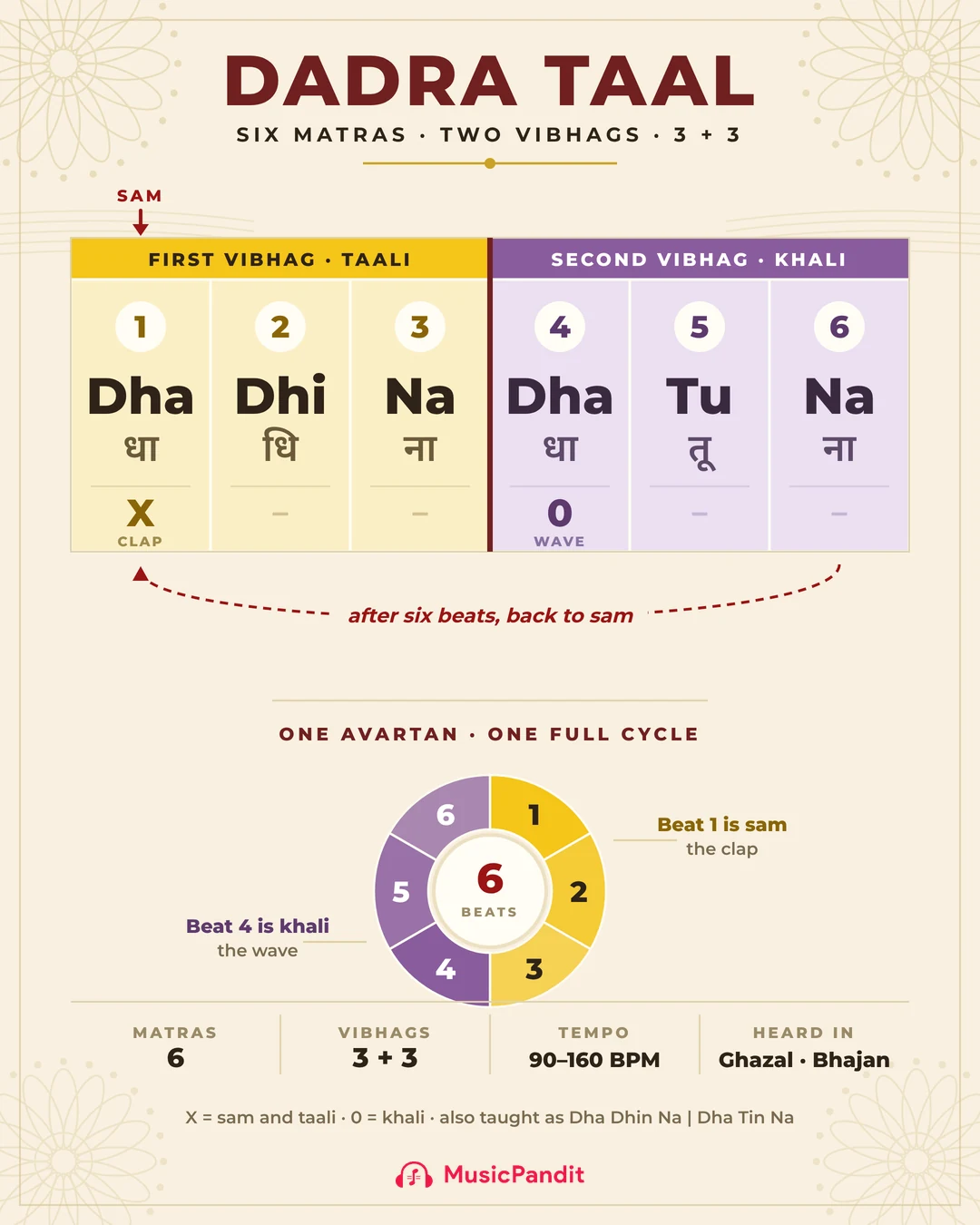
The Dadra Taal theka. Beat 1 is sam and takes a clap; beat 4 is khali and takes a wave.
| Beat | 1 | 2 | 3 | 4 | 5 | 6 |
|---|---|---|---|---|---|---|
| Bol | Dha | Dhi | Na | Dha | Tu | Na |
| Devanagari | धा | धि | ना | धा | तू | ना |
| Sign | X | 0 |
X = sam and taali · 0 = khali Read the pattern aloud: Dha – Dhi – Na | Dha – Tu – Na Then repeat it continuously. The first three bols form the opening vibhag. The next three complete the cycle. Different tabla traditions and musical settings may use variations such as Dha Dhin Na | Dha Tin Na. These variations preserve the six-beat structure, even when the percussion sounds change.
How to Count Dadra Taal with Claps and Waves
Beat 1: Clap — Say “Dha” and clap your hands. Beats 2 and 3: Count — Say “Dhi – Na” while keeping the pulse steady. Beat 4: Wave — Say “Dha” and gently wave your hand. Beats 5 and 6: Count and repeat — Say “Tu – Na”, then return to the first beat. Children should first practise slowly. Once they can maintain the rhythm comfortably, they can increase their speed.
Dugun and Tigun: Playing Dadra at Double and Triple Speed
Once a student can hold the theka steadily, teachers usually introduce laykari — playing the same bols at multiples of the original speed while the cycle itself stays the same length. In dugun, the bols are played at double speed, so the full theka fits twice into one cycle of six beats. In tigun, they are played at triple speed and fit three times. The count does not change. Only the density of the bols does. This is how students learn that tempo and rhythmic cycle are two separate things, and it is usually the first laykari exercise a tabla student meets.
Laggi in Dadra Taal
A laggi is a fast, decorative passage played towards the end of a song or between verses, usually in the lighter forms where Dadra is common. The tabla player leaves the plain theka and plays rapid, ornamental bols across the same six-beat cycle, then returns cleanly to sam. Laggi is one of the most recognisable features of Dadra accompaniment in ghazal and bhajan performance. Students should learn the plain theka securely first — a laggi only works if the underlying cycle never wavers.
Where Is Dadra Taal Used?
Dadra Taal appears in several styles of Hindustani and North Indian music.
1. Ghazal
Ghazal is the form most listeners associate with Dadra Taal. The six-beat cycle gives a singer room to stretch a line without losing the pulse, and the lighter khali half suits the conversational delivery a ghazal depends on. Much of the tabla accompaniment heard in ghazal recordings — including the laggi passages between couplets — is built on Dadra.
2. Thumri
Thumri is a light-classical vocal form that emphasises emotion, lyrical expression and melodic ornamentation. Dadra Taal is frequently associated with Thumri performances, especially when the music requires a gentle rhythmic movement. Its six-beat cycle allows singers to shape phrases expressively while remaining connected to the rhythm.
3. Dadra as a Musical Form
The word Dadra can describe both a taal and a light-classical musical form. Dadra as a vocal form often features romantic or devotional poetry. Its melodies may include expressive ornamentation and flexible phrasing. Although Dadra compositions commonly use Dadra Taal, the musical form is not restricted to this rhythm. Understanding this distinction prevents confusion between the composition style and its rhythmic accompaniment.
4. Bhajans and Devotional Music
Many North Indian devotional songs use Dadra Taal because its rhythm supports simple, memorable melodies. For children, a familiar bhajan can provide an enjoyable way to recognise the six-beat cycle. However, not every bhajan uses Dadra. The actual taal depends on the composition and arrangement.
5. Folk and Film-Inspired Music
Dadra’s 3+3 grouping also appears in folk-inspired melodies and popular music. Some Hindi film songs have a similar lilting, six-beat feel. Students should remember that a song in six beats does not automatically use the traditional Dadra theka. The melody’s phrasing and percussion accompaniment help determine its rhythmic identity.
Dadra Taal vs Keherwa Taal: What’s the Difference?
Dadra and Keherwa are among the most familiar rhythmic cycles in North Indian music. Both appear in bhajans, folk music, film music and light-classical performances. Their main difference is the number of beats and how those beats are grouped.
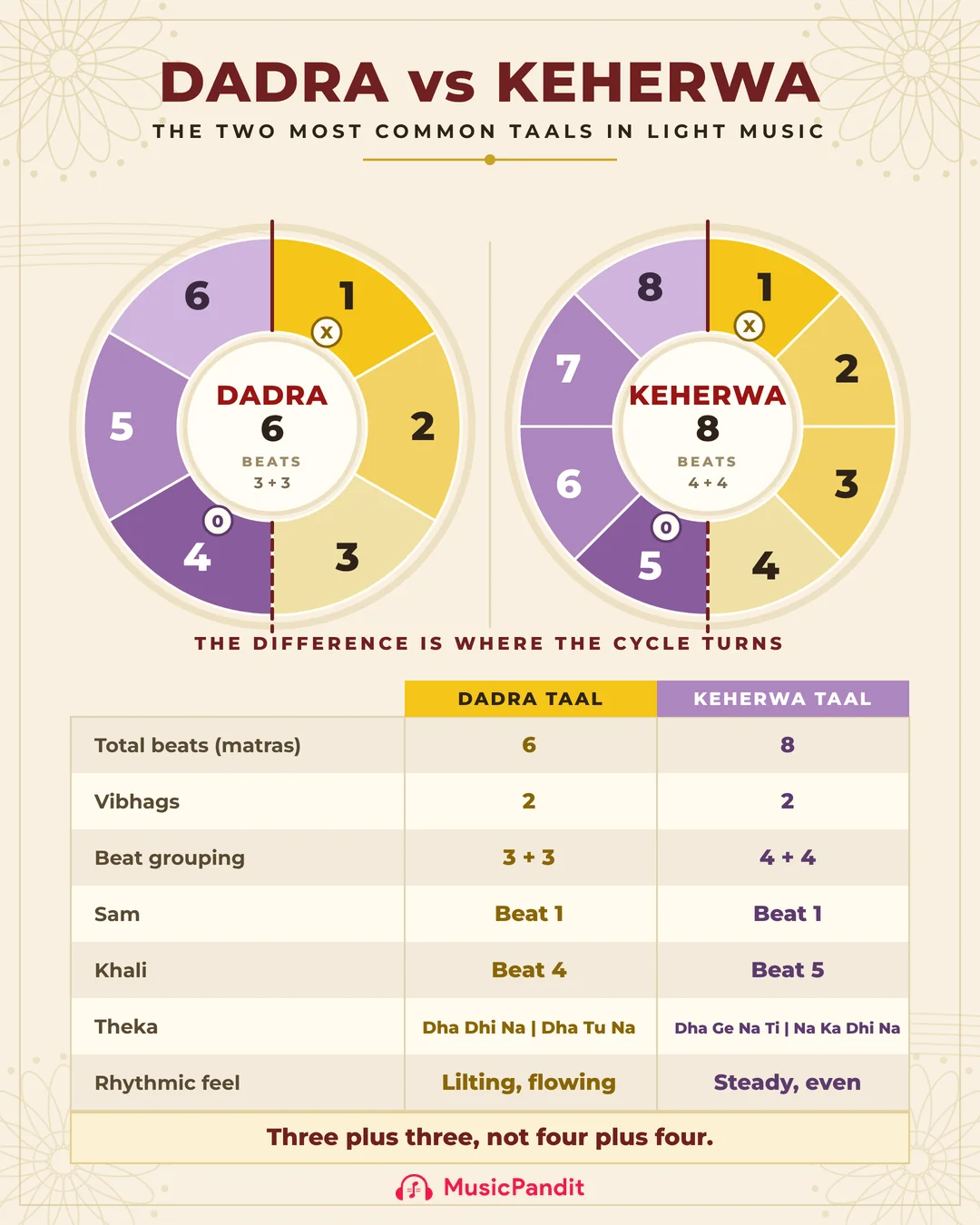
Dadra turns after three beats, Keherwa after four. That is the whole difference
| Feature | Dadra Taal | Keherwa Taal |
|---|---|---|
| Total beats | 6 | 8 |
| Vibhags | 2 | 2 |
| Beat grouping | 3 + 3 | 4 + 4 |
| Sam | Beat 1 | Beat 1 |
| Khali | Beat 4 | Beat 5 |
| Common theka | Dha Dhi Na / Dha Tu Na | Dha Ge Na Ti / Na Ka Dhi Na |
| Rhythmic feel | Often lilting and flowing | Often steady and even |
Dadra is often recognised through its two groups of three beats. Keherwa uses two groups of four beats, creating a different sense of movement. Both taals can be performed at different speeds and with different rhythmic variations.
A Simple Comparison Exercise
Clap six beats while saying: One – Two – Three | Four – Five – Six Repeat the pattern four times. Next, clap eight beats: One – Two – Three – Four | Five – Six – Seven – Eight Notice how the point of return changes. This exercise helps children understand that rhythm is organised into repeating cycles of different lengths.
Dadra Taal and Khemta Taal
Students sometimes meet a second six-beat taal called Khemta, and some teaching materials present the two names together. Khemta is also counted in six matras, but it is treated as a separate taal with its own bols and its own character — generally brisker and more folk-flavoured than the plain Dadra theka. In some regional traditions, particularly in eastern India, a faster Dadra variation is itself referred to as Khemta. For a beginner, the practical point is simple: six matras alone do not identify a taal. The theka does.
How to Practise Dadra Taal at Home
Dadra Taal can be practised without a tabla. Students only need their hands, a steady pulse and a little patience.
For Beginners at Home
- Sit comfortably and count from one to six aloud.
- Clap on beat one and wave on beat four.
- Repeat the cycle slowly for two minutes.
- Speak “Dha Dhi Na | Dha Tu Na” while keeping the beat.
- Practise for five minutes daily until the pattern feels natural.
Parents can join the activity by clapping along. This turns rhythm practice into an enjoyable shared exercise.
For Singers
- Begin by listening to a slow Dadra theka.
- Sing a comfortable note, such as Sa, while counting six beats.
- Practise a short sargam phrase across one complete cycle.
- Try singing a simple bhajan set to Dadra Taal.
- Return clearly to sam after each rhythmic cycle.
For example, students can sing: Sa – Re – Ga | Ma – Pa – Ga Then continue: Re – Ga – Ma | Ga – Re – Sa These are original learning exercises, not fixed compositions.
For Instrument Players
- Set a metronome to 60 BPM, with one click per beat.
- Count six clicks for each Dadra cycle.
- Play one note on every beat.
- Emphasise the first beat and recognise the fourth as khali.
- Gradually add simple melodies without losing the six-beat count.
Keyboard students can play six equal notes using one hand. Guitar students can practise gentle picking patterns organised into two groups of three. Tabla students should learn the correct strokes and bol pronunciation from their teacher. Once the cycle is steady at 60 BPM, students can work upward. Most light-classical and film settings sit somewhere between roughly 90 and 160 BPM, so a slow practice tempo is a starting point rather than the destination.
A Five-Minute Dadra Taal Practice Routine
| Step | Time | What to do |
|---|---|---|
| Find Sa | 1 minute | Sing or play Sa with a steady reference pitch. |
| Practise aaroh | 1 minute | Move slowly from lower Sa to upper Sa. |
| Practise avroh | 1 minute | Return through all seven notes. |
| Learn a phrase | 1 minute | Speak and play Dha Dhi Na | Dha Tu Na with careful timing. |
| Listen and compare | 1 minute | Hear a recording and identify sam and khali. |
Common Mistakes When Learning Dadra Taal
Beginners sometimes understand the six-beat count but struggle to maintain it during a song. These common mistakes can be corrected through simple practice.
- Counting eight beats instead of six → Practise Dadra and Keherwa separately until their groupings feel different.
- Clapping on beat four → Remember that beat four is khali. Use a wave instead.
- Rushing the second vibhag → Count all six beats evenly with a metronome.
- Forgetting sam → Emphasise beat one and practise returning to it after every cycle.
- Focusing only on the bols → Combine bol recitation with counting and hand gestures.
- Attempting laggi too early → A decorative passage only works over a cycle that never wavers. Secure the plain theka first.
Students should prioritise accuracy over speed. A slow, steady rhythm is more useful than a fast, uneven one.
Frequently Asked Questions About Dadra Taal
1. How many beats are there in Dadra Taal?
Dadra Taal has six beats, divided into two equal sections of three beats each. Its structure is written as 3+3. The first beat is sam and is marked by a clap. The fourth beat is khali and is marked by a wave. This structure repeats throughout the performance.
2. What are the bols of Dadra Taal?
A common Dadra Taal theka uses the bols Dha Dhi Na | Dha Tu Na. These six syllables represent the basic tabla pattern across two vibhags. Other versions, such as Dha Dhin Na | Dha Tin Na, are also taught. The six-beat structure remains the same despite these variations.
3. What is the difference between Dadra Taal and Keherwa Taal?
Dadra Taal contains six beats arranged in two groups of three. Keherwa Taal contains eight beats arranged in two groups of four. Dadra has khali on beat four, while Keherwa has khali on beat five. Both are widely used in devotional, folk and light music.
4. What is laggi in Dadra Taal?
A laggi is a fast, ornamental passage a tabla player uses between verses or towards the end of a light-classical song. The six-beat cycle continues underneath while the bols become rapid and decorative, before returning cleanly to sam. Laggi is especially characteristic of ghazal and bhajan accompaniment in Dadra.
5. Is Dadra Taal used in classical music?
Dadra Taal belongs to the rhythmic tradition of Hindustani classical music. It is especially common in light-classical forms, including ghazal, thumri and Dadra, as well as bhajans. It is less typical in major Khayal compositions than taals such as Teentaal or Ektaal. Its use depends on the composition and performance style.
6. Is Dadra Taal easy for beginners to learn?
Dadra Taal is generally beginner-friendly because it contains only six beats and two equal sections. Children can practise it through counting, clapping and waving before learning tabla bols. Once they understand sam and khali, they can try singing or playing simple melodies while maintaining the rhythmic cycle.
Related Music Terms
- Taal and Laya in Indian Music — the repeating rhythmic cycle that organises beats, and the tempo at which it moves.
- Ektaal in Hindustani Music — a twelve-beat rhythmic cycle divided into six sections.
- Bol Alap and Bol Taan in Hindustani Music — how syllables are used to shape melody and rhythm.
- Rhythm in Music — how sounds are organised in time across musical traditions.
- Beats per Minute — how musical speed is measured and counted.
- Khayal in Hindustani Music — the classical vocal form built around compositions and improvisation.
- Raga Bhairavi in Hindustani Music — the raga most often heard in thumri and dadra compositions.
Want Your Child to Really Understand Dadra Taal?
Your child will learn Dadra Taal naturally in our online Hindustani vocal classes, through structured lessons, enjoyable rhythm activities and regular teacher feedback. With patient guidance and consistent practice, they can develop the confidence to recognise, count and use rhythm independently.











 Chat with us